
eCommerce Lead Generation: 14 Strategies That Actually Work
Last updated on
by
eCommerce lead generation is the process of capturing contact information from online shoppers before they leave your store, so you can bring them back and convert them into buyers through email, SMS, or retargeting.
Most store owners treat this as an afterthought. They drive traffic, watch 97% of it disappear, and blame the ads. The stores that actually grow do the opposite: they treat every visitor as a lead opportunity before they treat them as a buyer.
This guide covers 14 strategies that work in 2026, whether you’re running a Shopify store, a WooCommerce site, or a custom eCommerce build. Each strategy is eCommerce-specific, not recycled from generic marketing advice, and includes real results from stores that have used them.
OptinMonster is a lead generation platform used by over 1.2 million websites to capture and convert visitors through behavioral targeting, exit-intent popups, and on-site optin campaigns. Several strategies below use it directly.
What Counts as an eCommerce Lead?
An eCommerce lead is any visitor who has given you a way to contact them again before leaving your store.
- An email from a signup form or popup
- A phone number for SMS
- A cart add without purchase (trackable via abandoned cart flows)
- A wishlist save or back-in-stock alert
- A quiz completion
- A social follow tied to a retargeting audience
Casual browsing doesn’t count. Intent signals do. Everything below is built around capturing those signals before visitors leave.
Deeper guide: What Is Lead Generation and How It Works (Complete Guide).
- 1. Build Your Email List With a Targeted Optin
- 2. Use Exit-Intent Popups to Recover Abandoning Visitors
- 3. Create Lead Magnets Built for eCommerce Buyers
- 4. Offer Discounts That Capture Emails, Not Just Sales
- 5. Run Limited-Time Offers With Countdown Timers
- 6. Use Quiz Funnels to Qualify and Capture Leads
- 7. Capture Leads From Your Product Pages
- 8. Personalize Campaigns for Returning Visitors
- 9. Gate Content to Capture Qualified Leads
- 10. Optimize CTAs So Visitors Actually Click
- 11. Use Live Chat to Capture and Qualify Leads in Real Time
- 12. Optimize for Mobile Lead Capture
- 13. Turn Social Followers Into Email Subscribers
- 14. Use SEO to Attract Leads Who Are Already Buying
1. Build Your Email List With a Targeted Optin

Email still has the best ROI of any eCommerce marketing channel. The commonly cited figure is $36–$42 back for every $1 spent. The reason isn’t that email is magic. You own the list. You’re not renting attention from a platform that can tank your reach whenever it wants.
The catch is that a list is only as good as what feeds it. A “subscribe to our newsletter” form is a dead end. Nobody wants a newsletter. They want something specific in exchange for their email.
The forms that actually convert pair the signup with an immediate reason to hand over an address:
- A first-order discount (10–15% works across most categories)
- Early access to a sale or new product drop
- A lead magnet tied to what the visitor was browsing
- A spin-to-win or coupon wheel
OptinMonster’s campaign builder lets you design those forms and show them to the right person at the right moment, based on how long someone’s been on the site, how far they’ve scrolled, which product page they visited, or whether they’ve already subscribed.
More on list-building: proven ways to grow your email list.
2. Use Exit-Intent Popups to Recover Abandoning Visitors

About 70% of eCommerce visitors leave without buying. Exit-intent popups catch some of them on the way out.
OptinMonster’s Exit-Intent® technology reads when a visitor’s cursor moves toward the browser bar, the clearest signal they’re about to close the tab, and fires a campaign in that window.
Some results from stores that use it:
- Crossrope grew its email list by 900%
- SnackNation pulled in 1,200 new leads per week
- Ryan Robinson grew subscribers by 500%
What makes this work in eCommerce specifically: you can match the offer to what the visitor was doing. Someone leaving a product page gets something different than someone walking away from a full cart. OptinMonster’s display rules let you target by page, cart value, traffic source, or conversion history.
“Wait, don’t go!” converts badly. “Before you leave: here’s 15% off what you were just looking at” is a different thing entirely.
3. Create Lead Magnets Built for eCommerce Buyers
eCommerce lead magnets work best when they solve a problem that exists between the visitor’s current state and the purchase decision. The mistake most stores make is borrowing from content marketing playbooks: ebooks, webinar recordings, long PDF guides. Those work for B2B. eCommerce buyers want something they can use right now.
Lead magnets that convert in eCommerce:
- Discount codes. The simplest exchange: email for savings. Works in almost every category.
- Size or fit guides. Genuinely useful for apparel, footwear, outdoor gear. Solves a real pre-purchase problem.
- Product comparison checklists. Good for higher-ticket items where buyers are still researching.
- Care and usage guides. Useful for capturing leads still in research mode.
- Quiz results. “Find your perfect X” quizzes collect an email to deliver a personalized recommendation.
The test for a good lead magnet: what’s stopping this visitor from buying? Whatever that answer is, that’s your lead magnet.
4. Offer Discounts That Capture Emails, Not Just Sales
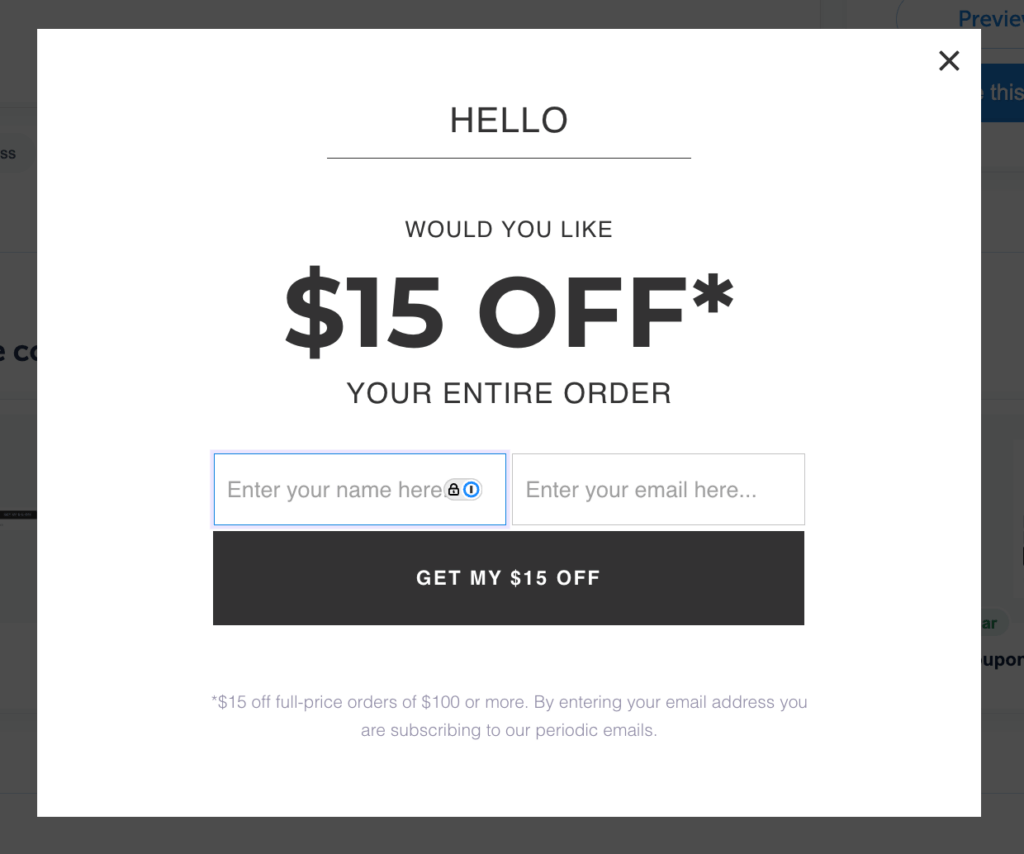
CouponFollow data shows 96% of shoppers look for a promo code before completing a purchase. Discounts work. The question is whether you’re capturing an email before handing one out.
The wrong way: a sitewide discount banner visible to everyone. You give away margin and get nothing back.
The right way: a discount delivered through an optin form. The visitor enters their email, gets the code in their inbox (or auto-copied via OptinMonster’s Coupon Marketing feature), and you’ve turned a price-motivated visit into a contact you can remarket to.
A few guardrails worth building in:
- Don’t run the same discount permanently. Rotate offers so buyers don’t learn to wait.
- Save bigger discounts for higher-commitment actions, like email plus phone or first purchase only.
- Use discount campaigns for new visitors. For returning customers, loyalty messaging works better.
More on structuring these: discount code ideas for eCommerce.
5. Run Limited-Time Offers With Countdown Timers
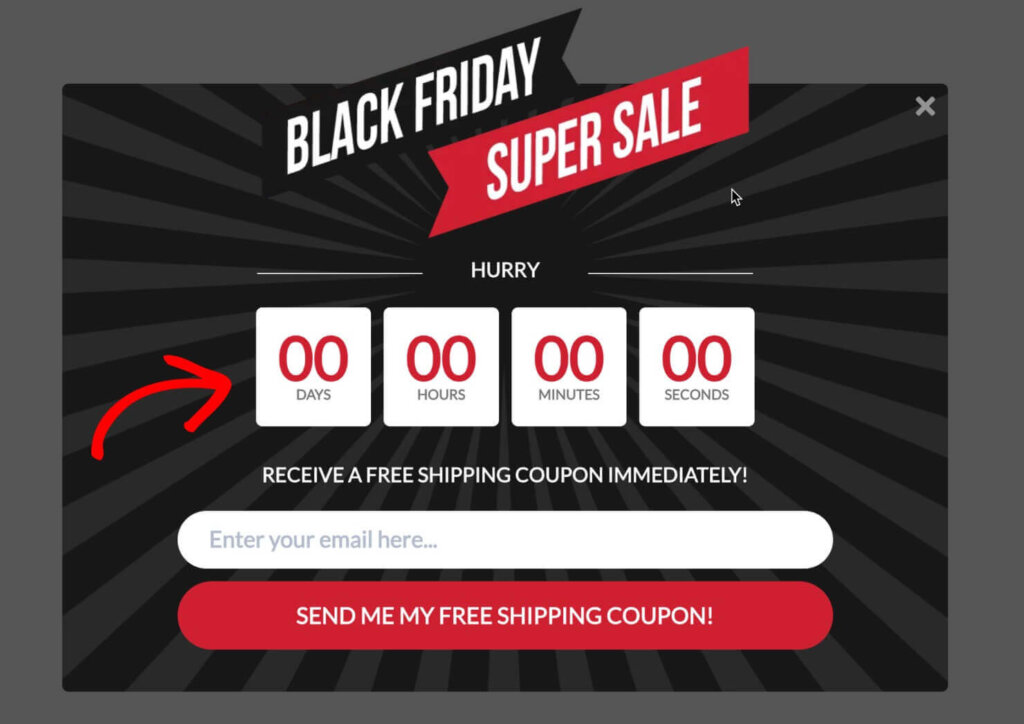
A product available indefinitely at a fixed price creates no urgency. The same product with a visible sale timer ending in 18 hours creates pressure to decide now.
OptinMonster’s countdown timer campaigns add a live, ticking timer to any popup or inline form. Cracku, an online coaching platform, used countdown timers and increased conversions by 300%.
Where they work best:
- Flash sales with a hard end time
- Holiday campaigns with delivery deadlines (“order by Dec. 20”)
- Limited-stock messaging where the scarcity is real
- First-time visitor offers that expire quickly
One rule that matters: don’t use fake timers that reset when the page reloads. Buyers notice. When they do, you lose both the sale and the trust. Only put a timer on a real deadline.
6. Use Quiz Funnels to Qualify and Capture Leads
Quiz funnels capture higher-quality leads than generic popups because they collect declared preferences alongside the email. A quiz funnel asks a question, collects answers across a few steps, and delivers a personalized recommendation gated behind an email. The visitor gets something genuinely useful. You get a lead who has already told you what they want.
Instead of capturing “someone who wanted a discount,” you capture “someone looking for hydrating skincare for dry skin with a $50–80 budget.” That contact is worth more to every email you send them afterward.
OptinMonster’s Smart Segmenter turns multi-step campaigns into quiz funnels, routing visitors to different outcomes based on their answers, without them ever needing to visit a product page.
This works especially well in categories where buyers need a recommendation before they can choose confidently: beauty and skincare, apparel and footwear, supplements, home goods. Anywhere the question “but which one is right for me?” would otherwise send someone to a competitor’s quiz.
7. Capture Leads From Your Product Pages
Product pages get the most purchase-intent traffic on a site. Someone who clicked into a specific product is closer to buying than someone browsing a category. That intent needs a capture mechanism.
Three tactics that work here:
Back-in-stock alerts. When a product is sold out, replace the add-to-cart button with a “notify me when available” email field. These are some of the most qualified leads you’ll collect. The visitor has told you exactly what they want.
Wishlist signups. A prompt to save a product (requiring an account or email) captures leads at the moment of interest, before they leave to comparison shop elsewhere.
Size or fit prompts. For apparel, an inline “not sure about sizing?” prompt that sends a fit guide collects an email from a visitor who might otherwise bounce on uncertainty.
Most stores put optins on the homepage and the blog and nowhere else. Product pages are where purchase decisions get made. That’s where capture needs to live.
8. Personalize Campaigns for Returning Visitors
A new visitor and a returning visitor who has already bought from you have different needs. Showing the same 10%-off popup to both is lazy and wastes the second impression.
OptinMonster’s Cookie Retargeting adjusts what someone sees based on their previous behavior: pages visited, whether they’ve already subscribed, what was in their cart, and more.
Expat.com used this to personalize campaigns for logged-in users based on which destinations they were browsing. The result was 30,000 new member registrations per month.
The most useful rules for eCommerce:
- Subscribers vs. non-subscribers. Don’t show an email capture to someone already on your list. Show them a product recommendation or a loyalty offer.
- Category visitors. Someone who has browsed footwear twice in two sessions is not a cold lead. Give them a footwear-specific offer.
- Cart abandoners. The highest-value retargeting audience you have. They need a different message than someone who never showed purchase intent.
9. Gate Content to Capture Qualified Leads
Gated content generates higher-quality leads than discount popups because visitors self-select based on specific interest rather than price sensitivity. It works by putting a signup requirement in front of something valuable enough that visitors trade their email to access it.
In eCommerce, the most effective gated content tends to be practical and close to the purchase decision:
- A comprehensive buying guide for a product category
- A lookbook or style guide
- A seasonal gift guide
- An exclusive sale or early access list
Photowebo used content gating with OptinMonster and increased conversions by 3,806%. Trading Strategy Guides used the same approach to add over 11,000 subscribers in just over a month.
OptinMonster’s Content Lock feature handles the technical side. The visitor sees a preview, hits a gate, submits their email, and gets access.
10. Optimize CTAs So Visitors Actually Click
The CTA is the line of text on a button. It’s also one of the most undertested elements in eCommerce.
“Subscribe” is weak. It describes an action from the store’s side, not a benefit from the visitor’s side. “Get my 15% off” is stronger because it names what the visitor gets. “Claim your free size guide” is stronger still because it’s specific about what they’re getting.
The gap between a 2% and 6% popup conversion rate is often just the CTA copy. Rich Page tested OptinMonster campaigns with improved CTA copy and increased conversions by 316%.
What works:
- First-person phrasing (“get my discount” vs. “get your discount” — test both, results vary)
- Specificity about the reward
- Urgency when it’s real (“claim offer, expires tonight”)
- No friction words: not “submit,” not “register,” not “sign up”
Test the button before assuming the form is the problem. It’s usually the button.
11. Use Live Chat to Capture and Qualify Leads in Real Time
Live chat catches leads that forms miss entirely. A visitor with a specific question who can’t find the answer doesn’t fill out a form. They leave. A chat widget can intercept that.
Research from Hiver shows 63% of buyers are more likely to purchase from a site that offers live chat. For higher-ticket items especially, the ability to ask a question before committing makes a real difference.
For lead generation specifically, live chat works because most tools collect a name and email before the conversation starts, capturing a contact even if the visitor never converts that session. It also surfaces the exact objections blocking purchases, which tells you what your product pages and campaigns are missing.
The best live chat tools for eCommerce push those contacts directly into your email platform so they flow into nurture sequences automatically.
12. Optimize for Mobile Lead Capture
Over 79% of eCommerce buyers used a mobile device to make a purchase in 2025, and Google indexes mobile-first. Mobile traffic is the majority for most eCommerce stores, but mobile conversion rates consistently lag desktop.
A popup that works on a 1440px screen becomes an unusable overlay on a 390px phone. The form fields are too small, the close button disappears, and the visitor bounces.
What actually closes the gap:
- Use scroll-based triggers on mobile instead of time-based ones. Mobile users start scrolling faster.
- One field only. Name, email, and phone on a mobile form kills completion rates. Email only.
- Make the close button large and obvious. If someone can’t dismiss it easily, they leave.
- Test fullscreen campaigns on mobile. A fullscreen welcome mat optimized for touch often outperforms a scaled-down popup.
Salt Strong built mobile-specific campaigns with OptinMonster and boosted conversions by 185%. Same offer, different format.
13. Turn Social Followers Into Email Subscribers
Social followers are not leads. They’re rented. If Instagram changes its algorithm or suspends your account, that audience is gone. An email list isn’t.
The most reliable way to move social followers into email: run paid lead gen campaigns on the platforms where they already are. Facebook and Instagram Lead Ads let someone submit their contact information without leaving the platform, which dramatically improves completion rates vs. sending people to an external landing page.
For organic conversion, the lever is a specific offer in the bio link. A link to a landing page with a real incentive (a discount, a lead magnet, early access) converts. A link to a homepage doesn’t.
“Sign up for our newsletter” as a social post is ignored. Specific offers with clear value are not.
14. Use SEO to Attract Leads Who Are Already Buying
SEO attracts leads with purchase intent because visitors arrive having already searched for what you sell, making them higher-quality than most paid traffic. The problem is that most eCommerce SEO advice is so generic it’s useless. “Do keyword research” and “write good content” are not strategies. Here’s what actually moves lead generation:
Target buying-intent queries. “Best running shoes for flat feet” has more purchase intent than “running shoes.” Product comparison and “best [product type for use case]” queries attract people close to a decision.
Optimize product and category pages. These pages get the most commercial traffic. Title tags, meta descriptions, and on-page headers should match how buyers search, not just how the brand names things.
Answer pre-purchase questions in content. “How to choose X” and “X vs Y” content attracts visitors in the consideration stage who can be captured as leads before they decide.
Link high-traffic posts to lead capture pages. Every blog post with meaningful traffic should point to a relevant product page or gated resource that collects an email.
Deeper guide: Beginner’s SEO Guide.
How eCommerce Lead Generation Works as a System
Individual tactics get you incremental wins. Treating lead generation as a system gets you compounding growth.
The basic version:
- SEO and paid traffic bring in visitors with purchase intent
- Behavioral triggers catch visitors before they leave
- Optin campaigns with specific offers turn anonymous visitors into contacts
- Email and SMS sequences move those contacts toward a first purchase
- Post-purchase sequences go after the second and third purchase
OptinMonster handles the middle layer (behavioral triggers and optin campaigns) across more than 1.2 million websites. It connects directly to the email platforms, CRMs, and eCommerce tools you’re already using, so the leads you capture move automatically into whatever comes next.
Frequently Asked Questions
What is eCommerce lead generation?
eCommerce lead generation is the process of capturing contact information from online shoppers (typically an email or phone number) before they leave your store, then using that contact to bring them back and convert them into buyers.
How do you generate leads for an eCommerce website?
The most effective methods are exit-intent popups, discount optins, quiz funnels, product page capture (back-in-stock alerts, wishlists), gated content, and live chat. The right mix depends on traffic volume, product category, and average order value.
What’s a good lead generation conversion rate for eCommerce popups?
The average in 2026 is around 4.8%, based on Wisepops data. Strong campaigns with tight targeting and a real offer reach 8–20%. Below 2% usually points to a weak offer, poor targeting, or CTA copy that doesn’t name a benefit.
How is eCommerce lead generation different from B2B?
eCommerce (B2C) leads have shorter sales cycles, days or weeks rather than months, and the buyer is one person making a personal decision. That means eCommerce lead gen relies on urgency, discounts, and immediate value rather than the slow relationship-building common in B2B.
What tools work best for eCommerce lead generation?
OptinMonster for on-site behavioral targeting and optin campaigns. Klaviyo or Drip for email automation. Intercom or Gorgias for live chat.
Related reading:
Disclosure: Our content is reader-supported. This means if you click on some of our links, then we may earn a commission. We only recommend products that we believe will add value to our readers.
One response to “eCommerce Lead Generation: 14 Strategies That Actually Work”
-

Nice overview — concise and practical. Quick question: for small Shopify stores with limited traffic, which two strategies here tend to give the fastest measurable lift in captured leads (email or SMS) without a big budget? Also, any tips on testing which lead magnet resonates first?

Add a Comment