
What Is a Flash Sale? How to Run a Flash Sale & Promote It
Last updated on
by

Is there stock on your shelves that just isn’t selling? Maybe the month is nearly over and you haven’t made as much revenue as you wanted. Or you need cash sooner than your usual sales cycle will deliver it.
A flash sale could be the answer, but most stores run the same setup that doesn’t really work.
In this guide, I’ll show you how to plan and run a flash sale that actually makes you money. I’ll also share tips from successful sales we’ve run on OptinMonster.
What Is a Flash Sale, and Is It Worth Running One?
A flash sale is a time-limited promotion offering huge discounts on a limited selection of products. The deadline adds pressure for a visitor to make a decision now.
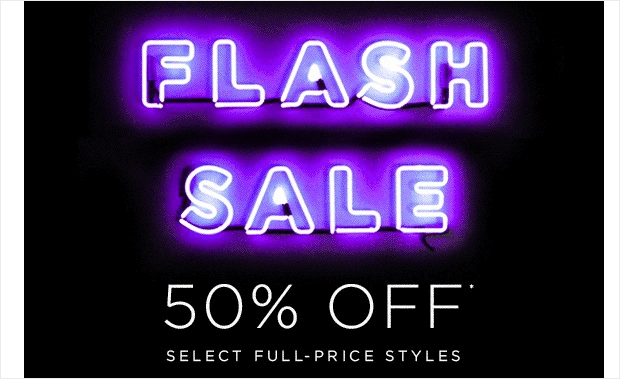
Without a deadline, a deep discount and a narrow selection of products, you are running an ordinary sale, not a flash sale.
So, is it worth running one? Usually yes, with one condition: you need a real reason the price goes back up.
That condition is backed by data. The American Marketing Association wrote up a 2023 Journal of Marketing Research study by Jillian Hmurovic, Cait Lamberton and Kelly Goldsmith. They found that online time-limited promotions often do worse than the same promotion with no deadline on it.
Deadlines work when the reason for them sits outside your control, like a holiday or a change of season. So weigh each benefit below against that test.
Here are the main benefits of running a flash sale:
- It builds a real sense of urgency, so people are more likely to take action and buy while the window is open.
- It clears excess inventory by moving stock instead of carrying it another quarter. This is particularly helpful for out-of-season products.
- It can earn attention on your social media platforms, because a limited-time deal is timely news.
- It brings in cash quickly, though flash sales reduce the profit margin of each item you sell, so the overall profit has to make up for it.
4 Effective Flash Sale Examples
Each example below is a real promotional email. For each one, I analyzed how long the sale ran, how big the discount was, and who could claim it to help you copy the flash sales that work.
1. BoxLunch Flash Sale: Sitewide Discount
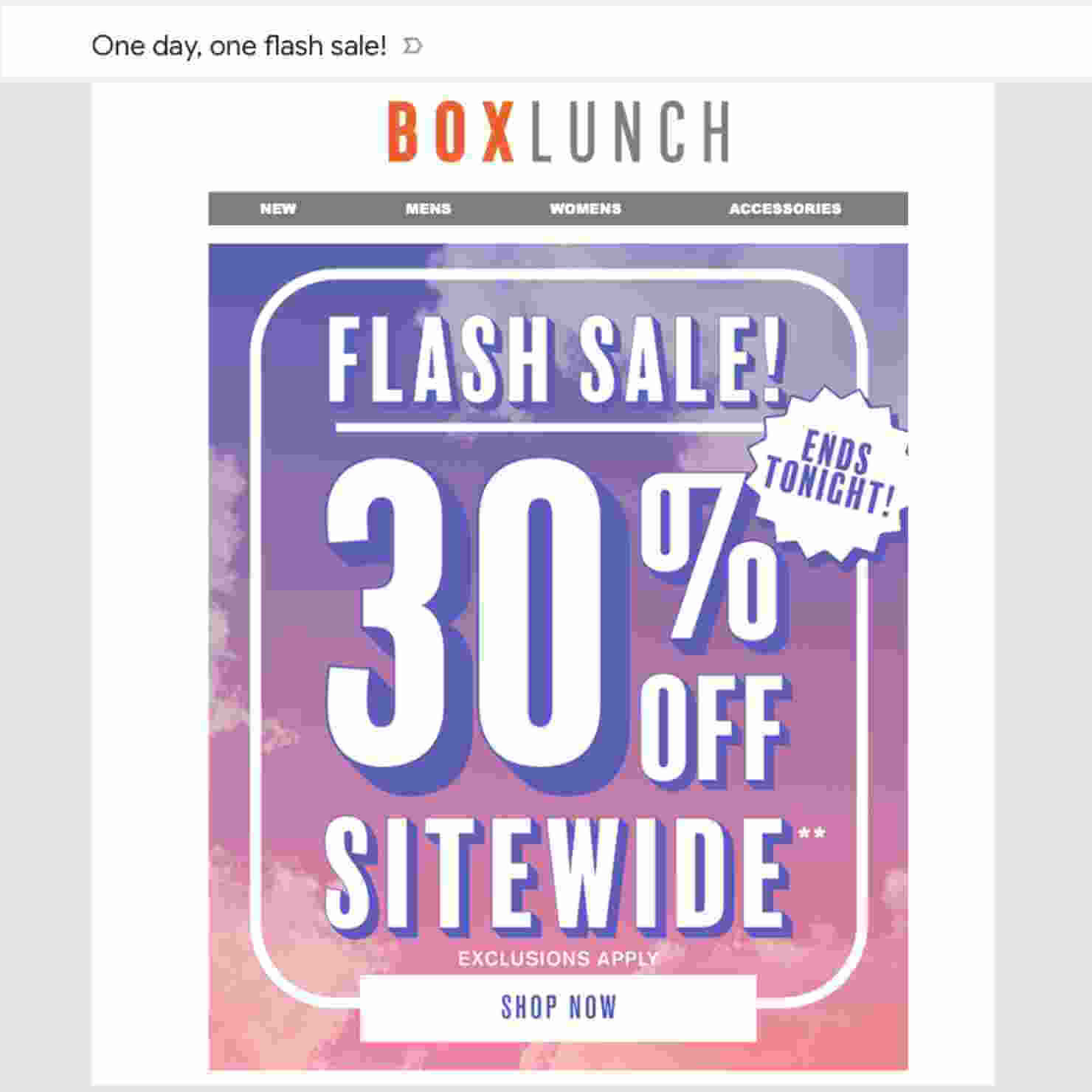
I’ll start with the plainest one: a single discount on everything you sell, for one day. That’s what BoxLunch does here.
- How long: one day
- Discount: 30% off, sitewide
- Conditions: none stated
Why it works: a sitewide discount removes the shopper’s hardest question, which is whether the thing they already want is even included. I recommend keeping a first flash sale this plain, and putting the percentage and the deadline in the subject line of your promotional email.
Read next: 101 email subject lines your subscribers can’t resist
2. Planet Fitness Flash Sale: Exclusive Deal for New Members
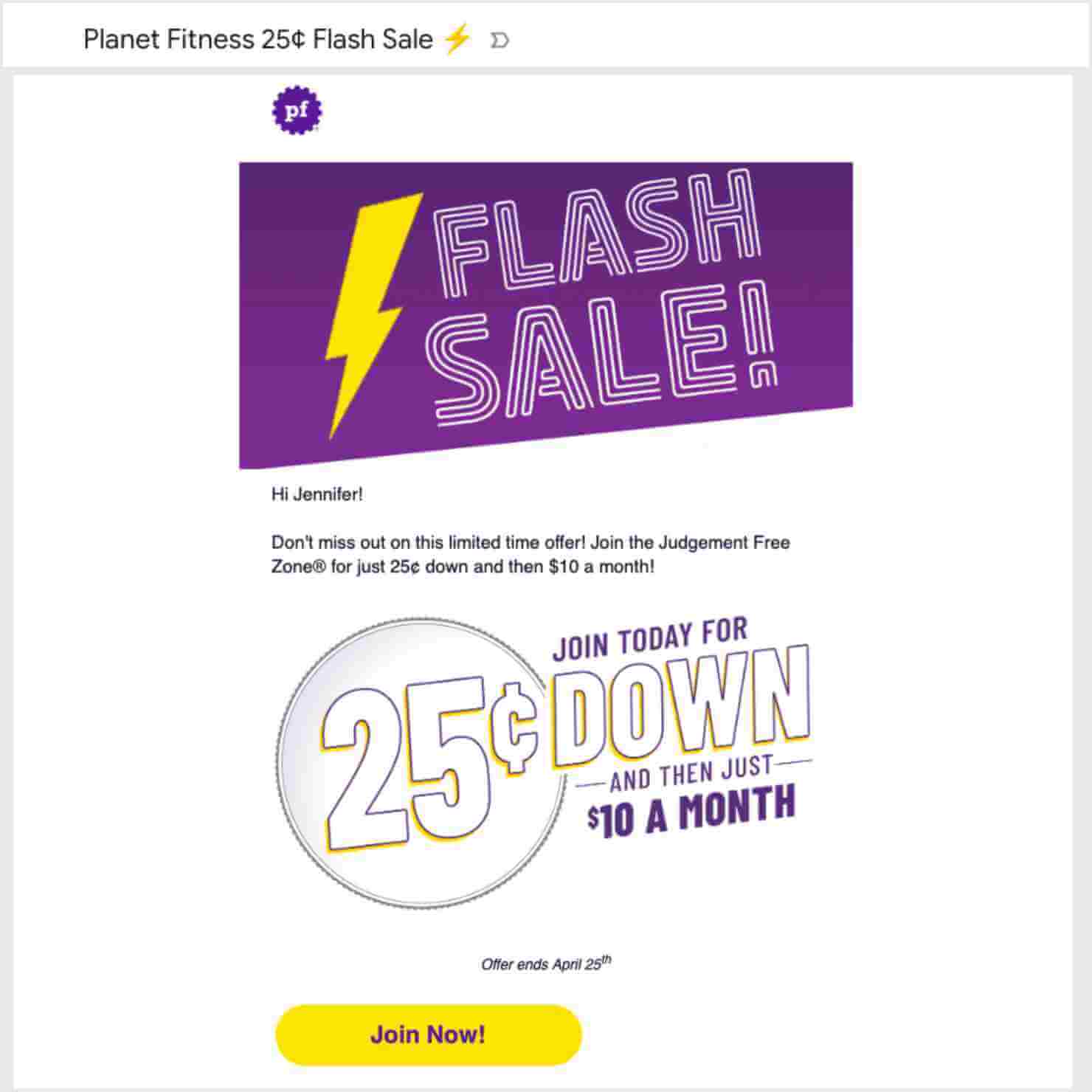
A membership business can use the same approach to sign up a lot of new members at once. In this email, the gym Planet Fitness offers a limited-time deal to join for just 25¢, followed by a monthly fee of $10.
- How long: until a named end date
- Discount: 25¢ to join, then $10 a month
- Conditions: new members only
Why it works: the 25¢ removes hesitancy around the joining cost, which is usually the part that makes somebody put the decision off. So, if your pricing carries a setup fee or a first-month cost, then that’s the number I’d discount, not the recurring one.
3. Maurices Flash Sale: Special Event Deal
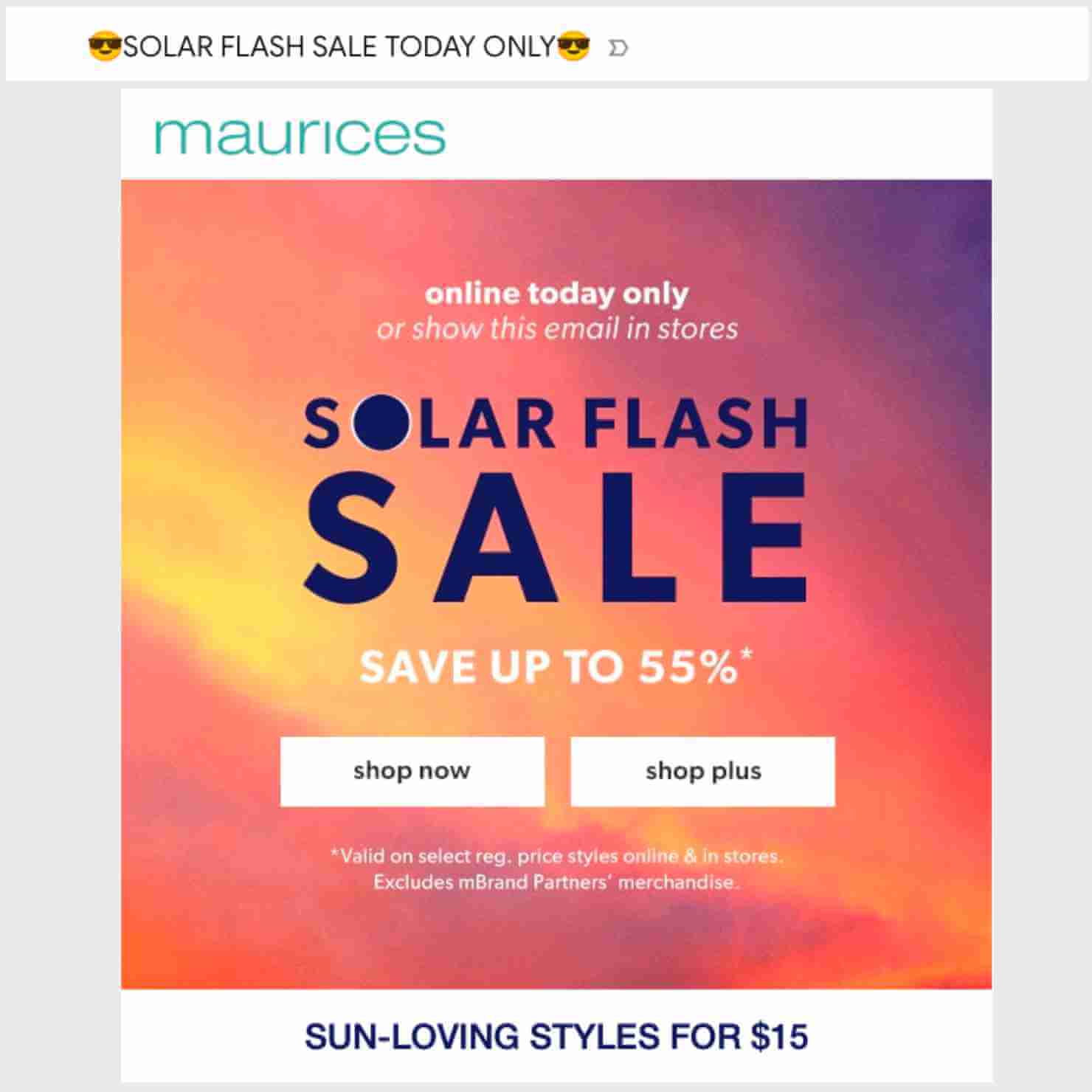
Clothing retailer Maurices built a one-day flash sale around a solar eclipse, discounting what the email calls “sun-loving styles.”
- How long: one day, per the “Today Only” subject line
- Discount: up to 55% off
- Conditions: the sun-themed range only
Why it works: the eclipse set the deadline, and Maurices took advantage of it. I recommend finding the event your products already suit, and let that event set the end time of your sale.
Read next: How to use urgency to increase your conversion rate
4. The New Yorker Flash Sale: Discounted Subscription + Free Gift
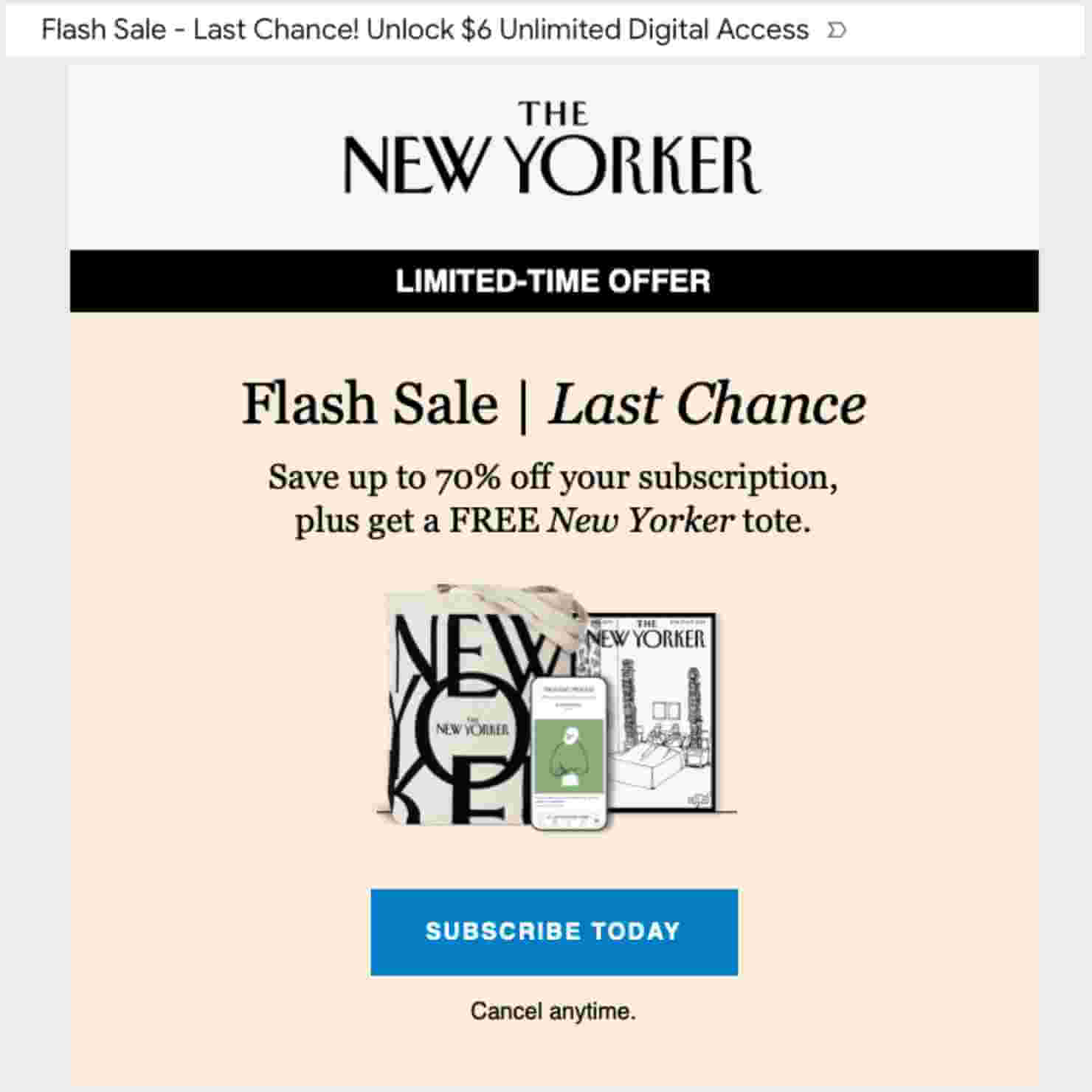
BoxLunch and Maurices both discount a one-off purchase. A subscription is completely different because the saving covers a whole year. In this last-call email, The New Yorker cuts the price of a digital subscription and adds a free tote.
- How long: not stated, and this is the final-day email
- Discount: up to 70% off, at $6 for unlimited digital access
- Conditions: the tote comes with the subscription
Why it works: the customer gets a discount on their subscription, so they’re more likely to stay subscribed. Plus, the tote is the part they won’t be able to get later. So if you have no room left to discount, I’d add something small and physical and let that expire with the sale.
Tips for Planning a Flash Sale
Here are the steps we follow whenever we plan a flash sale:
- Set clear goals: Before you launch, decide what you want to achieve. Do you want to clear out inventory, boost sales of a specific item, or attract new customers?
- Choose the right sale products: Select flash sale items that will benefit from a discount and generate excitement. Consider including slow-moving inventory or past-season items. Flash deals can also give a boost to new products and best sellers.
- Make it a time crunch: Flash sales thrive on urgency. We run our own flash sales in a 24 to 72 hour window, and that’s the range I suggest you start with. If your marketing usually reaches your audience quickly, then you can even limit your sale to just a few hours.
- Offer a compelling discount: Deep discounts can entice customers to buy, but you also have to consider your profit margins. Your discount should catch attention but not be so high that you don’t earn a profit. Possible flash sale discounts include a percentage off, a fixed dollar amount, or free shipping. It’s tempting to raise your regular prices before the sale so the discount reads as bigger, but I recommend you don’t. Discount from the price you’ve actually been selling at.
- Prepare your website: Make sure your website can handle a surge in traffic. Test all functionality beforehand, and have clear calls to action so customers can easily find the sale items.
- Manage inventory accurately: Avoid stockouts that can disappoint customers. Have a realistic idea of how much inventory you have for each sale item, and monitor your stock levels in real-time throughout your sale period.
- Promote well: Prepare your marketing well before the sale starts. You can use your website, email marketing, and social media channels to build excitement and reach your target audience.
When it comes to promoting on your own website, I recommend using popups and automating them to start and finish with your sale. This means your popup or floating bar will turn itself on when your sale opens and off when it closes.
You can also add a Countdown Timer block, so visitors see the same deadline you scheduled. We only use a countdown when the deal really does expire, and a flash sale does. For full details, see our guide on how to schedule your marketing campaigns.
How to Promote a Flash Sale on Your Website
Your website is where a flash sale reaches everybody at once. This includes loyal customers who check in regularly, shoppers who were already close to buying, and first-time visitors who just found you online.
For your biggest sales, like Black Friday and Cyber Monday, you will likely update your entire homepage to focus on the sale. But that’s a lot of work to put in for smaller flash sales, especially if you’re a small business.
So, for a one-day or one-weekend sale, I’d leave the website alone and put the offer in a campaign that sits on top of it: a popup, a floating bar, or an inline form on the pages that already get traffic.
These are the kinds of campaigns we use to run our own flash sales.
First, you’ll want to make sure you have an email marketing platform to collect leads and send discount coupons to your users. Then, you’ll need a powerful lead generation tool like OptinMonster. It comes with 700+ campaign types, including popups designed specifically for flash sales.
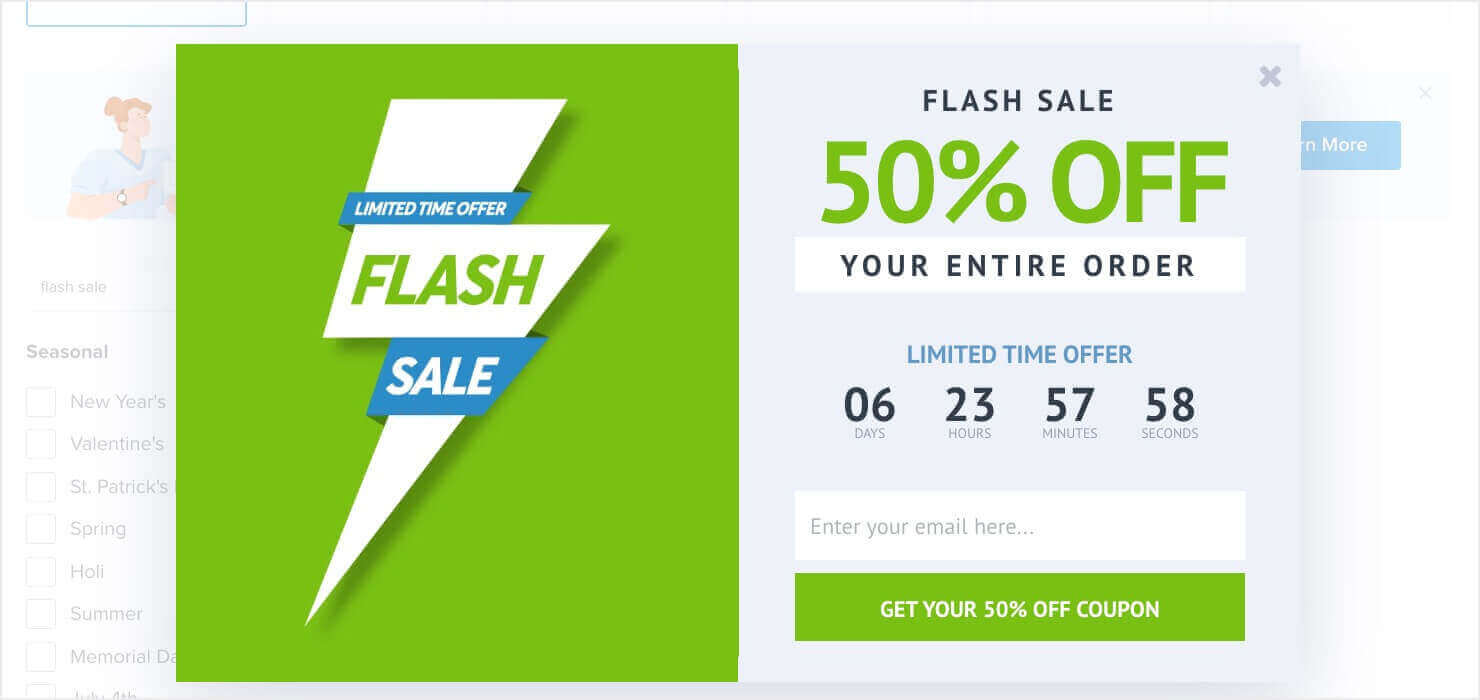
A lightbox popup puts the discount and the countdown in front of the page, so it’s the version people notice first:
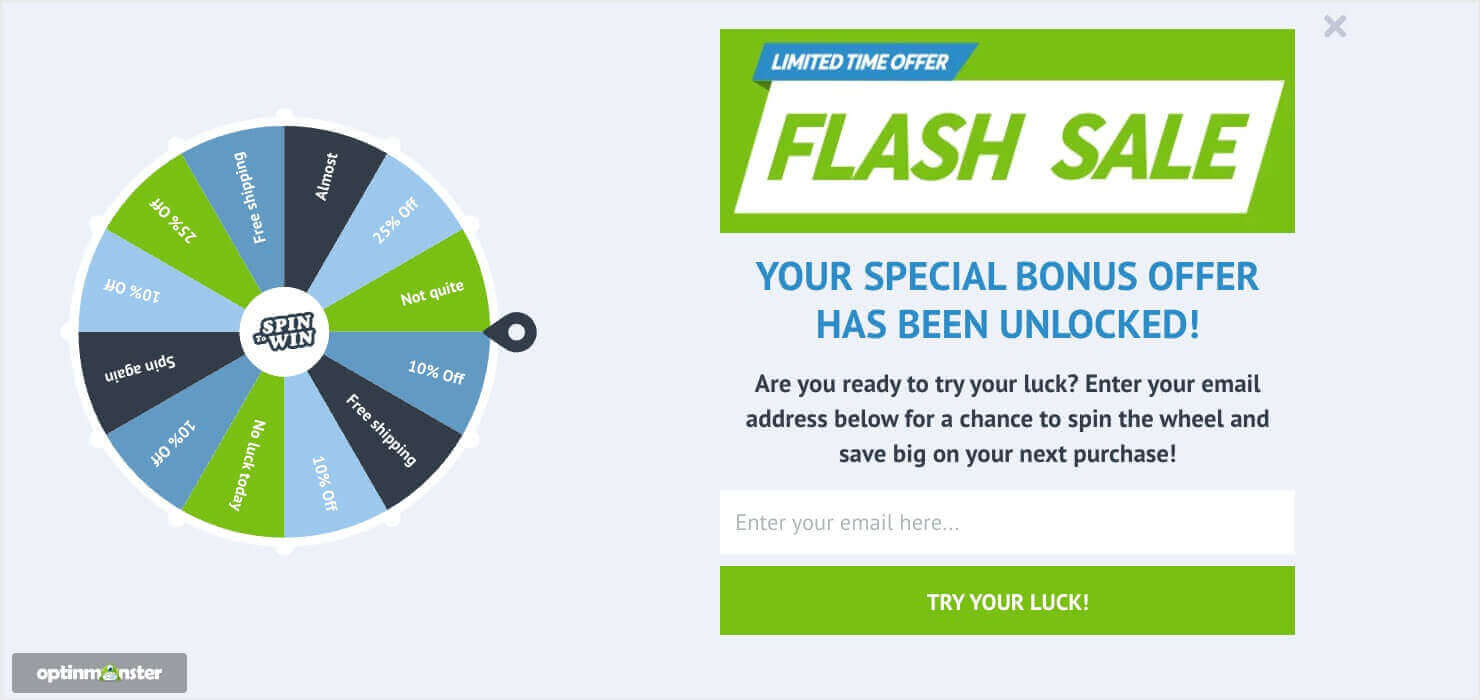
A coupon wheel then turns the discount into a gamified spin, so the visitor earns the code instead of you handing it over.
This can increase engagement with your sale.
On the other hand, a floating bar pins the sale to the top or bottom of the screen and stays there while people scroll, so it keeps selling on every page of your website:

For our own flash sales, I always run a floating bar, and the most recent one paired that floating bar with a lightbox popup.
Here’s a customized floating bar on optinmonster.com for our spring sale:
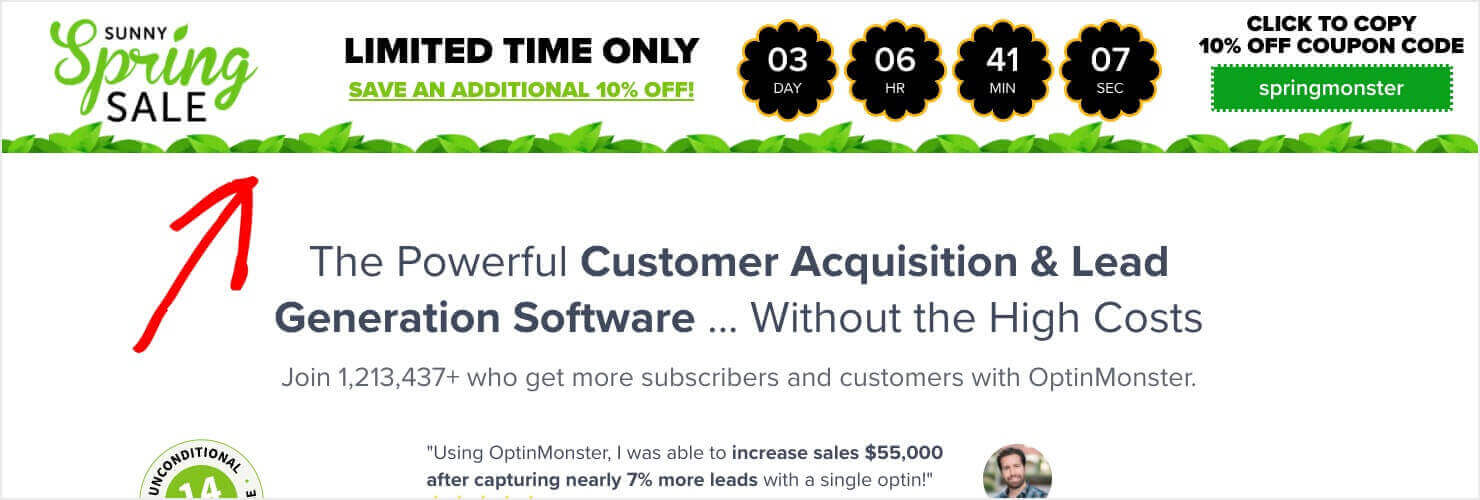
Once you’ve finished the design, Display Rules decide who sees the campaign and when, and this is where I would spend the most time.
Three rules matter most for a flash sale:
- Exit-Intent® Technology: Catches people as they move to leave and shows the sale one more time. You can also trade a bigger discount for their email address. In our case study with Fastrack, 53% of abandoning visitors clicked through on a limited-time discount popup.
- Page-Level Targeting: Matches the offer to whatever someone is reading. In our case study with FitSmallBusiness, one offer matched to the content category people were browsing converted at 40.38%.
- Geo-Location Targeting: Shows a different deal by location, so an in-store offer only reaches the cities you can serve. In our case study with Aish.com, a geolocation-targeted campaign converted 5.15% over 30 days.
Before a sale opens, an exit-intent popup with a timer counting down to the start builds the list you email on day one. If you offer an extra 10% off for a name and an email address, then you have the strongest lead magnet you can run during a sale, plus a list of people who already asked for the discount. That is what the email sequence that I cover below runs on.
Important: If you are buying traffic, then the ad and the campaign must have the discount, the same deadline, and the same code. Our guide on boosting the ROI of PPC campaigns with targeted optins covers this in full.
Finally, before the sale opens, make sure your checkout process is as quick as you can make it. A sale that drives traffic to a slow checkout will likely lose you the customer.
How to Run a Flash Sale Email Sequence
Email campaigns are extremely effective for flash sales for the following reasons:
- Reach the subscribers who already asked to hear about your sales.
- Put your deadline in front of people at the moment they check their inbox.
- Get people talking about the sale before it opens.
- Drive traffic to the sale while the window is still open.
A Typical Flash Sale Email Sequence
There are 4 parts to the typical flash sale email sequence:
- Announcement
- Launch
- Last day (for multi-day sales)
- Last call
A flash sale runs 24 to 72 hours. So all four emails have to land inside about three days, and I’ll cover them one at a time.
Flash Sale Email #1: Announcement
The first email tells your list that a sale is coming. I recommend putting the phrase “flash sale” in your subject line where you can, the way the examples above do. Other options are phrases like “today only” or “tomorrow.”
Here’s an announcement email from Bath & Body Works. The subject line went out the day before the sale opened:

The email itself gives the details:
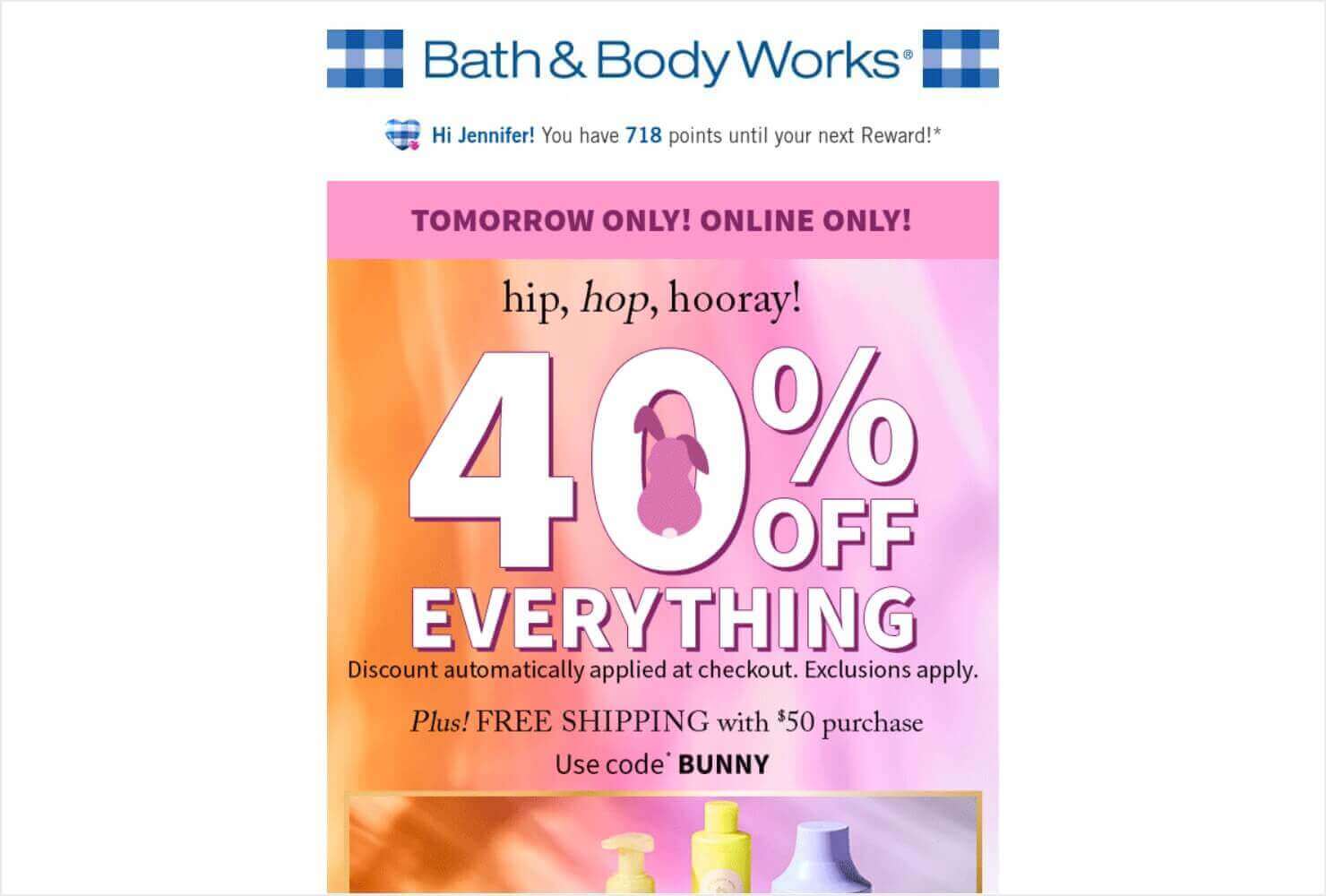
These are the three things you should include in every announcement email:
- The discount amount
- Which items are going on sale
- The date or length of the promotion
The email example above covers all three. It’s 40% off, it runs across the whole online store apart from a few exclusions, and it lasts one day, starting the next day.
It also carries a graphic to catch attention, which is standard for eCommerce marketing emails. If you don’t have a designer, you can build one yourself with visual content creation tools like Canva or Adobe Express.
Flash Sale Email #2: Launch
This is the email your customers have been waiting for. It tells them the sale has started.
Launch emails should be short and sweet. You can add a little information about the offer, but the main job is getting people to click through to your site.
Bath & Body Works sent theirs on the morning of the sale, with a subject line beginning “today only”:

Inside, they added an extra deal before repeating the main announcement:
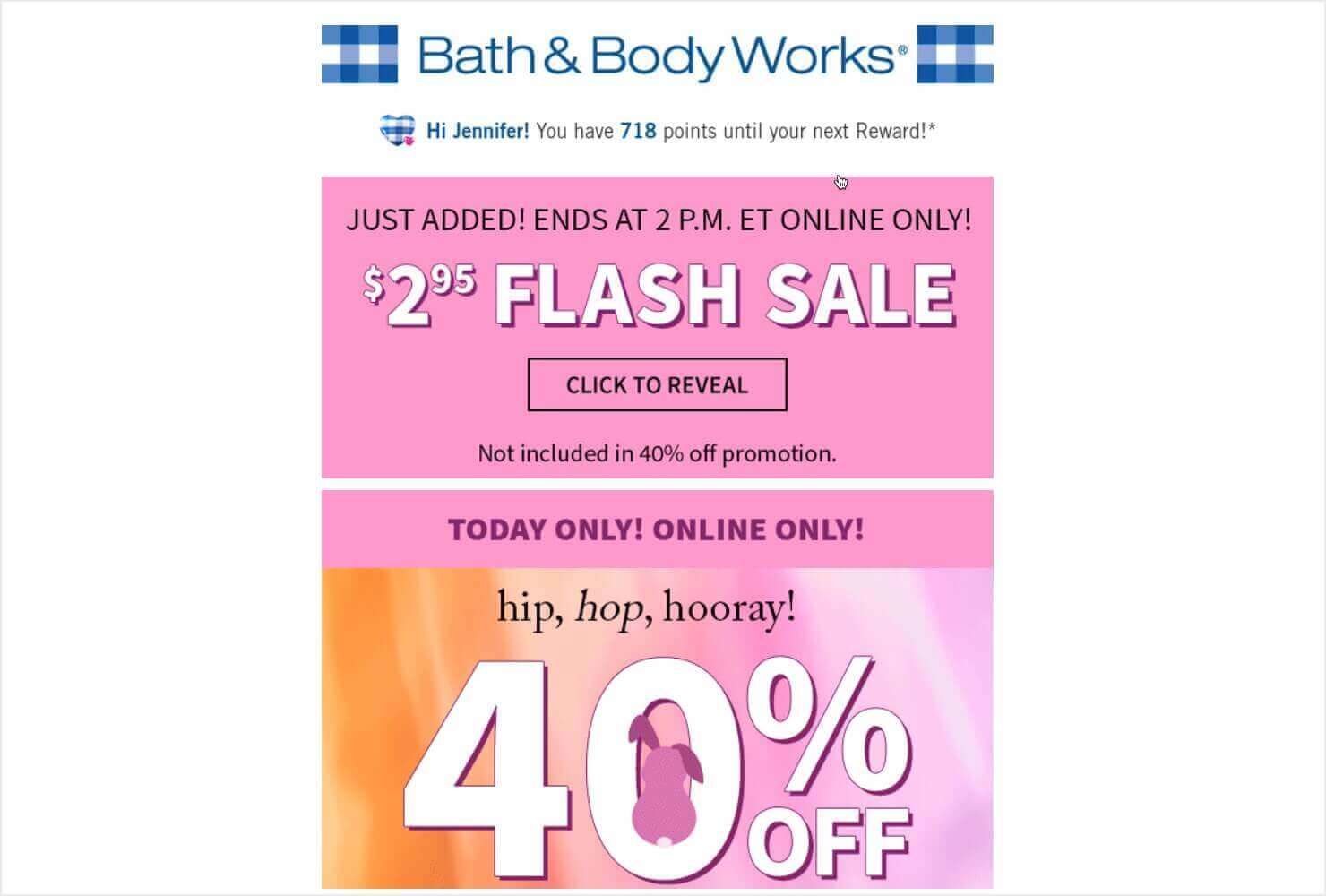
If your sale is store-wide, you could also include links to all of your categories so people can jump straight to their own section:
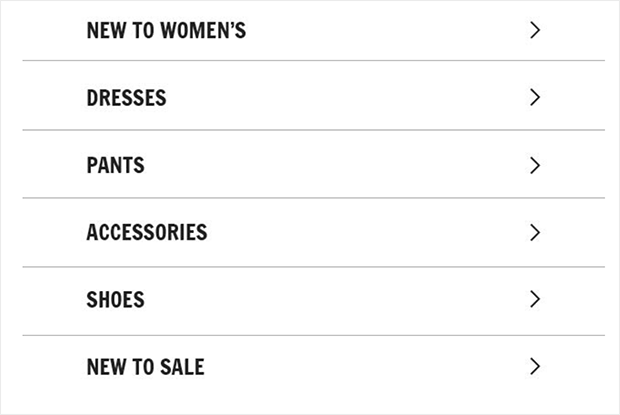
Navigation links help visitors buy faster, and they improve user experience (UX) at the same time.
Flash Sale Email #3: Last Day
If your sale runs longer than a day, then make sure to send a last-day email.
People will always look for reasons to put off a purchase, especially if they know they have a couple of days to get to it. A last-day email reminds them that the time is nearly gone, while they still have long enough to redeem the offer.
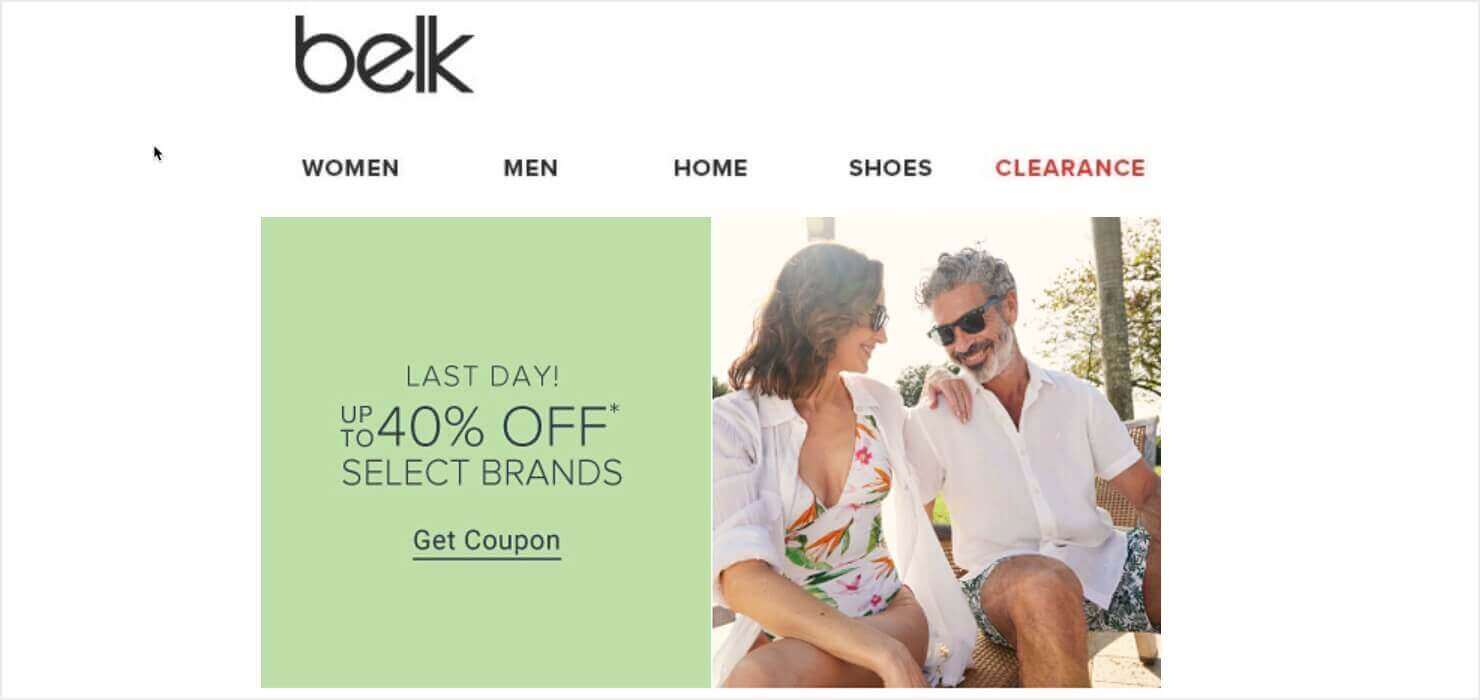
Here’s an example from Belk. The subject line tells the reader about the deadline and the discount at the same time:

The email itself keeps it simple.
There’s a link for the coupon, plus category links to shop the site:
Flash Sale Email #4: Last Call
Scarcity-based campaigns work because most people put off a decision until something pushes them. A final email lets customers know that your sale is going to end soon, and a lot of them will act on it.
I suggest sending your last email 4 to 6 hours before the flash sale ends. People tend to procrastinate until the last minute, so this final reminder will convince many to take advantage of the deal.
This is a last-call email from Amy Porterfield. It does 2 things to create more urgency:
- It puts “Final Hours” in the subject line.
- It opens by telling the reader there are only 3 hours left to get the deal.
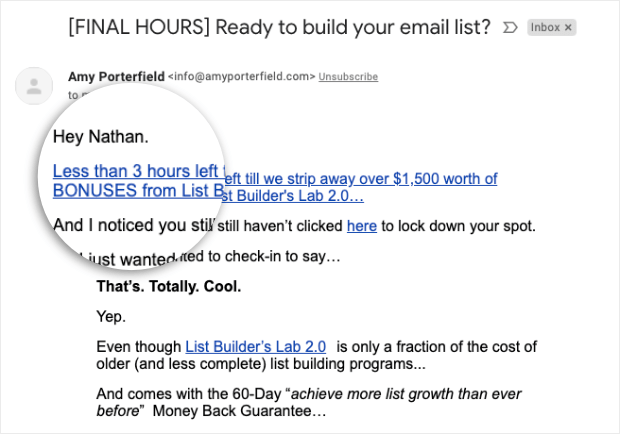
She also repeats the same product link in 3 separate places. That makes it easy for someone to move from a last-call email to your sales page or product pages.
Plan Your Own Flash Sale Email Series
The exact number of emails your own sale needs will vary.
For instance, if you’re planning a 1-day sale, then you won’t need a last-day email. You also may not always want to give advance notice of a sale. After all, that might stop people from going ahead and making a purchase at full price.
In that case, 2 emails are enough, the launch and the last call. But if you’re running a 2 or 3-day sale and you want to build excitement for it, I suggest sending all 4. By then, your customers should be ready to buy.
For more on writing the emails themselves, see our guides below:
- Email Copywriting That Sells: Simple Ways to Write Better Marketing Emails
- Killer eCommerce Email Examples to Impress Your Subscribers
Flash Sale FAQs
How does a flash sale work?
You cut prices sharply on a small group of products and set a short deadline. Then you announce it everywhere your customers already see you: your website, your email list, and your social accounts. We use a window of 24 to 72 hours for our own sales.
Are flash sales actually worth it?
Yes, when the deadline has a reason a shopper can see. Online time-limited promotions tend to be less effective than the same offer with no time limit, because shoppers online are more alert to being sold to.
How often should you run a flash sale?
Run a flash sale as often as you have a real reason for one, and not more than that. I recommend spacing your flash sales throughout the year to avoid flash sale fatigue.
If you run too many back-to-back promotions, you may train your customers to ignore the deals or kill the sense of urgency you’re trying to create. You also risk lowering the perceived value of your products.
How to create a successful flash sale strategy?
Start with the goal, because it decides which products go on sale. A sale to clear old stock is a different sale from one that wins new customers. Then pick a short window and give it a reason from outside your business, like a season change or a holiday.
Your discount needs to be deep enough for shoppers to notice and shallow enough to keep your margin. Make sure the site and the stock are ready before you announce anything. Then plan the emails: an announcement, a launch, a last day, and a last call. We send our last call 4 to 6 hours before the sale closes.
Run Your First Flash Sale
Creating a discount is the easy part, but making sure that people actually hear about the sale before the window closes is harder. That’s the job we built OptinMonster for.
Get started with OptinMonster today!
Related Resources:
Disclosure: Our content is reader-supported. This means if you click on some of our links, then we may earn a commission. We only recommend products that we believe will add value to our readers.
Add a Comment