
Your subject line decides whether your email gets read or deleted.
Not your design. Not your offer. Not your copy. The subject line is the first thing your subscriber sees, and if it doesn’t earn the open, nothing else gets a chance.
At OptinMonster, I’ve tested subject lines across our own campaigns and studied what drives opens at scale. The finding is consistent: the best subject lines either spark curiosity or create urgency. Everything else is a variation on those two levers.
This guide gives you 150+ proven examples organized by type: sales, professional, FOMO, follow-up, re-engagement, and more. Each section includes the formula that makes those subject lines work.
- What Makes a Great Email Subject Line?
- Six Subject Line Formulas That Drive Opens
- FOMO Email Subject Lines
- Curiosity-Inducing Email Subject Lines
- Funny Email Subject Lines
- Professional Email Subject Lines
- Catchy Email Subject Lines
- Personalized Email Subject Lines
- Pain Point Email Subject Lines
- Sales Email Subject Lines
- Welcome Email Subject Lines
- Thank You Email Subject Lines
- Event Email Subject Lines
- Follow-Up Email Subject Lines
- Re-Engagement Email Subject Lines
- Cold Email Subject Lines
- Newsletter Subject Lines
- Words and Phrases That Boost Open Rates
- Email Subject Line Mistakes to Avoid
- Frequently Asked Questions
What Makes a Great Email Subject Line?
Here’s what the research actually shows.
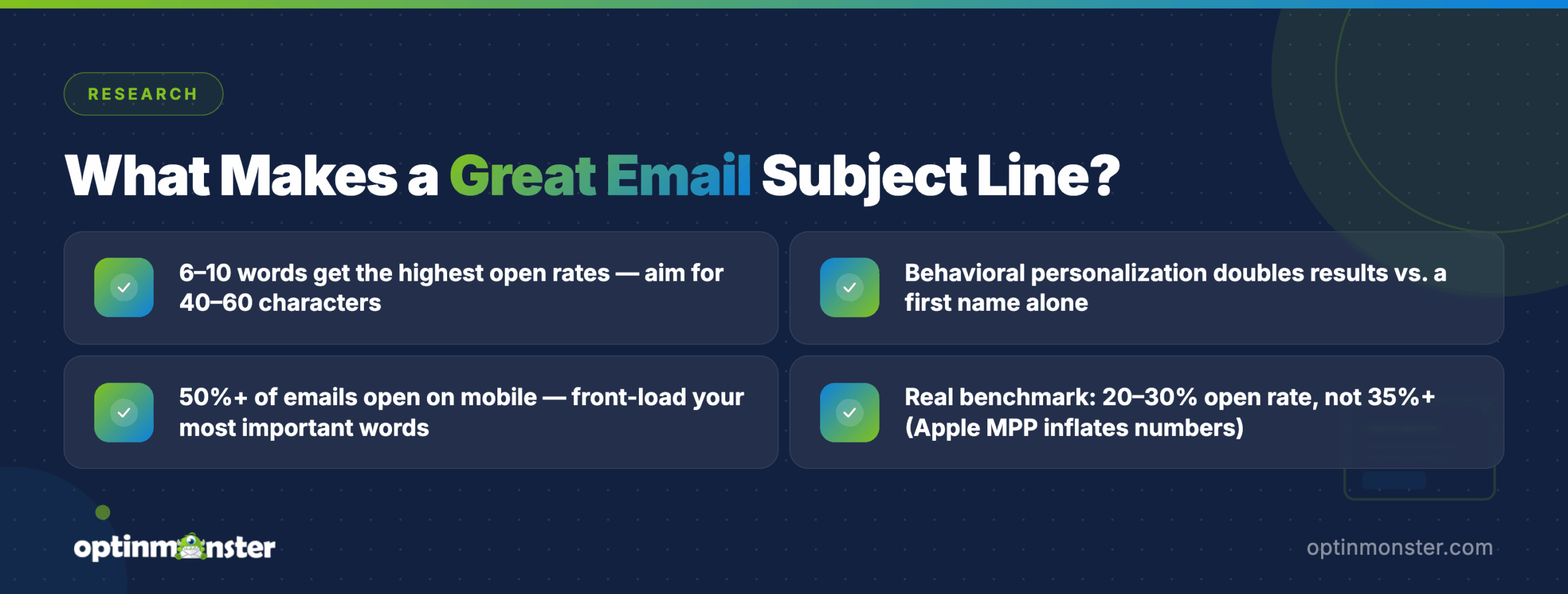
Length matters, and word count beats character count. Subject lines with six to ten words generate the highest open rates, according to research from Retention Science. That’s roughly 40 to 60 characters. On mobile, front-load the important words so nothing gets cut off.
Personalization helps, but relevance helps more. Adding a subscriber’s first name to a subject line improves open rates by roughly two percentage points on its own. What actually moves the needle is behavioral personalization. Referencing a recent purchase or a resource they downloaded can double those results.
Mobile is where your email lives or dies. More than half of all emails are now opened on mobile devices. That means your subject line is competing for attention on a screen smaller than your hand. Keep it tight. Keep it specific. Earn the open in the first four words.
Your open rates may surprise you. According to Mailchimp’s 2023 benchmark data, the average email open rate across all industries is 35.63%, with ecommerce at 29.81%. Those numbers are inflated by Apple’s Mail Privacy Protection, which pre-loads tracking pixels. Without that effect, a realistic benchmark is closer to 20 to 30% for most industries.
Six Subject Line Formulas That Drive Opens
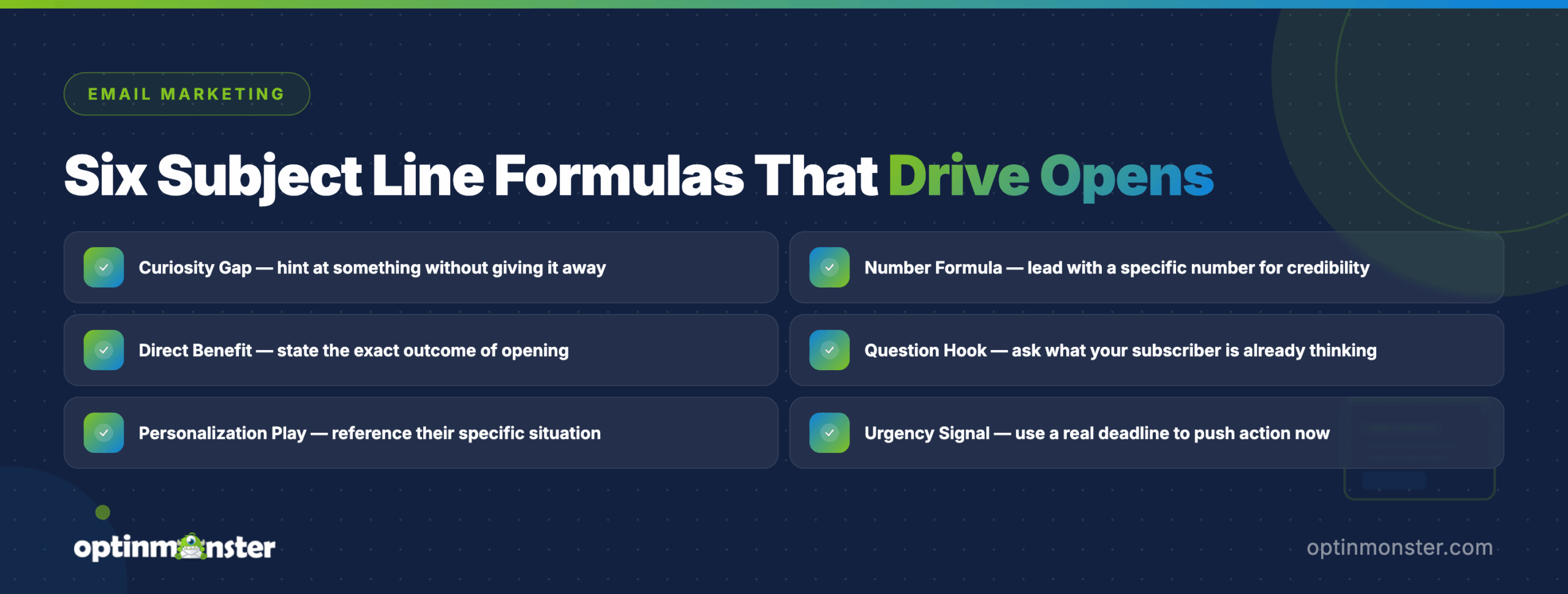
Most high-performing subject lines follow one of six patterns. Once you recognize the formula, you can apply it to any campaign.
The Curiosity Gap. Hint at something interesting without giving it away. Example: “We found something surprising in your data”
The Number Formula. Lead with a specific number. Specificity signals credibility. Example: “7 subject lines that doubled our open rate”
The Direct Benefit. State the exact outcome the reader gets by opening. Example: “How to double your email list in 30 days”
The Question Hook. Ask the question your subscriber is already thinking. Example: “Are you making this email marketing mistake?”
The Personalization Play. Reference something specific about the subscriber’s situation. Example: “[First name], your guide is ready”
The Urgency Signal. Use a real deadline to push action now, not later. Example: “Last day: 40% off ends at midnight”
Every example in this guide maps to one of these six formulas. Use them as a starting point, then adapt to your brand voice.
FOMO Email Subject Lines
Fear of missing out is one of the strongest open-rate drivers in email marketing. These work best when the scarcity or deadline is real. Manufactured urgency destroys trust fast.
- “This deal disappears in three hours”
- “Only 11 spots left — claim yours”
- “Last chance: your discount expires tonight”
- “You’re about to miss this”
- “We’re closing enrollment at midnight”
- “48 hours left to lock in your price”
- “Your invitation expires tomorrow”
- “Don’t close this email yet”
- “Everyone else already grabbed theirs”
- “This is the last time we’re offering this”
- “Your free trial ends in 24 hours”
- “We’re selling out faster than expected”
Curiosity-Inducing Email Subject Lines
These subject lines open a loop the reader has to close. Use them when you want strong opens without giving away the offer in the subject.
- “The weird thing behind our highest-converting page”
- “I wasn’t going to share this”
- “Here’s what we found when we actually tested it”
- “This email is a little different”
- “You might not want to hear this”
- “Something unexpected just happened with our results”
- “The one question you should ask before every send”
- “We almost didn’t tell you about this”
- “What nobody tells you about email marketing”
- “We ran the numbers. The results were surprising.”
Funny Email Subject Lines
Humor breaks the pattern. A funny subject line stands out in a crowded inbox, so make sure the tone matches your brand before you go this route. When it lands, the opens are hard to beat.
- “We messed up. Here’s how you benefit.”
- “This email is 99% less boring than your last meeting”
- “Sorry, this isn’t a cat video. But it’s close.”
- “Shocking: you might actually like this one”
- “We tried to write a boring subject line. We failed.”
- “You have better things to do. This takes two minutes.”
- “Not another Monday email. This one’s different.”
- “Your inbox called. It wants something good.”
- “We bribed our team with coffee to make this for you”
- “Plot twist: you’re going to want to open this”
Professional Email Subject Lines
These subject lines work for outreach, workplace communication, and formal follow-ups. They’re not designed to maximize open rates through tricks. They’re designed to get read and respected.
Business Outreach
- “Quick question about [project or topic]”
- “Following up on our conversation from [day]”
- “Introduction: [Your Name] from [Company]”
- “Meeting request: 20 minutes this week?”
- “Checking in — any updates on [topic]?”
- “Proposal for [Project Name] — attached”
- “Action required: please review by [date]”
Meetings and Calendar
- “Confirming our call on [day] at [time]”
- “Can we reschedule to Thursday?”
- “Agenda for [Meeting Name] on [Date]”
- “Reminder: [Meeting Name] starts in one hour”
- “Notes from today’s meeting — see below”
Professional Follow-Up
- “Still interested? Happy to answer any questions”
- “Re: [Topic] — one more thought”
- “Any updates on the [project or proposal]?”
- “Touching base from our call last week”
- “Just wanted to make sure this didn’t get buried”
Formal and Report-Based
- “Q1 performance summary — ready for your review”
- “Update: [Project Name] status as of [Date]”
- “New policy effective [Date] — please read”
- “Your invoice from [Company] is ready”
- “Contract sent — please review at your convenience”
Networking
- “Great meeting you at [Event Name]”
- “Your advice from [Event] — here’s what happened”
- “A quick favor — takes two minutes”
Catchy Email Subject Lines
Catchy subject lines are memorable without relying on urgency or mystery. They work well for brand-building campaigns where the goal is engagement over immediate conversion.
- “The email you’ll actually want to open”
- “What’s working in email marketing right now”
- “Stop sending emails nobody wants to read”
- “Your subscribers want this — are you giving it to them?”
- “The subject line that outperformed all the others”
- “We rewrote our homepage. Here’s what we learned.”
- “Everything you think you know about open rates is wrong”
- “The one change that transformed our email list”
- “Why your best emails are being ignored”
- “Email marketing in 2026: what actually works”
Personalized Email Subject Lines
The best personalized subject lines do more than insert a name. They reference behavior or recent activity. That’s where the real lift comes from.
- “[First name], here’s your personalized recommendation”
- “You left something behind, [First name]”
- “Based on your recent visit — we picked these for you”
- “Happy [anniversary or birthday], [First name]. Here’s a gift.”
- “You downloaded [Resource] — here’s the next step”
- “[First name], your account needs attention”
- “We noticed you haven’t tried this feature yet”
- “A follow-up on your recent [purchase or action]”
- “You’re almost at [milestone]. Here’s what’s next.”
- “Since you liked [previous content], you’ll love this”
Pain Point Email Subject Lines
These subject lines work because they name the exact frustration your subscriber is already experiencing. When someone reads a subject line and thinks “that’s exactly my problem,” the open is almost guaranteed.
- “Tired of emails that nobody opens?”
- “Why your list is growing but your revenue isn’t”
- “Is your email list actually working for you?”
- “The open rate problem most marketers ignore”
- “Getting traffic but not enough sales? Read this.”
- “Your welcome email is costing you subscribers”
- “What to do when your engagement drops overnight”
- “Still sending the same email to everyone? Here’s why that hurts.”
Sales Email Subject Lines
Direct, conversion-focused lines for promotional campaigns. Keep these honest and specific. Vague promotional lines get ignored; specific ones get clicks.
- “40% off — today only”
- “Your exclusive offer is inside”
- “Here’s the deal we promised you”
- “New: [Product Name] is now available”
- “Introducing [Product] — early access for subscribers”
- “We lowered the price. Here’s why.”
- “Buy one, get one — this weekend only”
- “Your cart is ready. So is your discount.”
- “Everything in the sale section — one more day”
- “We’ve never offered this before”
Welcome Email Subject Lines
Welcome emails have some of the highest open rates of any email type. Your subscriber just took action. This is the moment to set expectations and deliver immediate value. Don’t waste it on a generic “Thanks for signing up.”
- “Welcome to [Brand Name] — start here”
- “You’re in. Here’s what’s next.”
- “Thanks for joining — here’s your gift”
- “Your account is ready, [First name]”
- “Before you do anything else, read this”
- “Everything you need to get started — in one email”
- “We’re glad you’re here. Let’s start with this.”
- “Three things to do right now with your new account”
Thank You Email Subject Lines
Thank you emails are underused and underestimated. Sent well, they deepen loyalty and prompt repeat action without feeling transactional.
- “Thank you, [First name] — we mean it”
- “Your order is confirmed. Here’s a small thank-you gift.”
- “You made our year. Here’s something in return.”
- “We appreciate you. Here’s what’s coming next.”
- “From our team to yours — thank you”
- “You’ve been with us for a year. Let’s celebrate.”
- “Your feedback helped us improve this — here’s what changed”
- “Because of you, here’s what we built”
Event Email Subject Lines
For webinars, conferences, product launches, and live events. The goal is to drive registrations first, then attendance.
- “You’re invited: [Event Name] on [Date]”
- “Just announced: [Event Name] registration is open”
- “Seats are filling up — grab yours for [Event]”
- “Reminder: [Event Name] starts tomorrow”
- “Your link to join [Webinar Name] — starts in one hour”
- “[Event Name] recap — here’s what you missed”
- “Early bird pricing for [Event] ends Friday”
- “Join us live: [Topic] — [Day] at [Time]”
Follow-Up Email Subject Lines
Follow-ups make people uncomfortable to write. They shouldn’t. A good follow-up subject line is honest, low-pressure, and gives the reader an easy out.
- “Did you get a chance to look at this?”
- “One last nudge — then I’ll leave you alone”
- “You never responded. Totally fine. But…”
- “Still thinking it over? Here are your options.”
- “We saved your cart — it’s waiting for you”
- “You started something — let’s finish it”
- “Re: my last email”
- “One more thing before I follow up again”
Re-Engagement Email Subject Lines
For subscribers who haven’t opened in 60 to 180 days. These subject lines have one job: get the open. Keep them short, direct, and low-pressure.
- “We miss you, [First name]”
- “Are you still interested in hearing from us?”
- “It’s been a while. A lot has changed.”
- “We saved something for you — but not for long”
- “Should we stay in touch? Yes or no.”
- “Before we say goodbye — one last offer”
- “Your account has been quiet. We noticed.”
- “Here’s what you’ve been missing”
Cold Email Subject Lines
For first-touch outreach to people who haven’t opted into your list. The goal is relevance and respect. Not tricks.
- “Quick idea for [Company Name]”
- “Saw your post on [Topic] — had a thought”
- “Mutual connection suggested I reach out”
- “Question about your recent [announcement or article]”
- “I helped [similar company] achieve [specific result] — curious if relevant”
- “Not a mass email — specifically for you”
- “[Referral name] suggested I send this”
- “Two sentences on why I’m emailing”
Newsletter Subject Lines
For recurring newsletters and digest-style emails, the subject line needs to communicate value at a glance. Subscribers should feel like they’re getting the best of the week, not more inbox clutter.
- “This week’s must-reads — [date]”
- “What we learned this week”
- “The [Brand] weekly: [teaser of top story]”
- “Three things worth your time this Friday”
- “What everyone’s talking about in [industry]”
- “Your [weekly or monthly] roundup is here”
- “The story everyone missed this week”
- “What’s working in [industry] right now”
Words and Phrases That Boost Open Rates
Certain words consistently outperform others across email campaigns. Here’s what to use, and why.
- “You” and “your”: Direct address outperforms third-person every time
- Numbers (“7 ways,” “30 days,” “three mistakes”): Specific figures imply credibility and set expectations
- “Free”: Still works, especially for content offers and trial invitations
- “Now” and “today”: Signals immediacy without manufacturing fake urgency
- “New”: Novelty triggers curiosity reliably
- “Because”: Explaining the reason behind an action increases response
- “Easy” and “simple”: Reduces the reader’s perceived effort
- “Proven”: Signals credibility without overpromising
- “Exclusive”: Implies insider access
- “Reminder”: Works well in sequences; signals value without pressure
Email Subject Line Mistakes to Avoid
Even great writers make these errors. Check every subject line against this list before you hit send.
All caps or excessive punctuation. Writing “OPEN THIS NOW!!!” triggers spam filters and looks desperate. It also signals low production value to your subscriber.
Vague subject lines. “Check this out” and “Important update” give the reader no reason to open. State what’s inside.
Misleading subject lines. A subject line that doesn’t match the email content destroys trust instantly. Subscribers won’t open your next email, and many will unsubscribe.
Lines longer than ten words. Subject lines that truncate on mobile lose their meaning. Front-load the value.
Spam trigger words. Phrases like “free money,” “act now,” and “100% guaranteed” increase the chance your email lands in a junk folder before it’s ever seen.
Skipping the A/B test. Every audience responds differently. Testing two subject line variations on every campaign is how you learn what your specific list responds to. If you’re not testing, you’re guessing. Here’s how to set up email A/B tests that actually tell you something useful.
Subject line writing gets better with repetition. Use the formulas. Pick the category. Send the test. Your list will tell you what resonates.
The other half of the equation is having enough subscribers to email. OptinMonster converts your site traffic into subscribers, so the list you’re sending to keeps growing. Start your OptinMonster subscription today.
Frequently Asked Questions
What Is a Good Email Open Rate?
According to Mailchimp’s 2023 benchmark data, the average email open rate across all industries is 35.63%. Ecommerce sits at 29.81%. Both figures are inflated by Apple’s Mail Privacy Protection, which pre-loads tracking pixels. Without that effect, a realistic target is 20 to 30% for most industries. The most useful benchmark isn’t the industry average — it’s your own previous sends.
How Long Should an Email Subject Line Be?
Research from Retention Science found that subject lines with six to ten words generate the highest open rates. That’s roughly 40 to 60 characters. On mobile, aim for the shorter end of that range so your subject line displays in full.
What Words Should I Avoid in Email Subject Lines?
Avoid: “free money,” “click here,” “100% guaranteed,” “no obligation,” “winner,” and excessive use of exclamation marks or dollar signs. These trigger spam filters and can keep your email out of the inbox entirely. Also avoid vague phrases like “check this out” or “important update.” They give subscribers no reason to open.
Should I Use Emojis in Subject Lines?
Yes, when they fit. A single relevant emoji at the start or end of a subject line makes your email stand out visually in a packed inbox. Using them randomly or overusing them looks spammy. Test before you commit to them consistently.
How Much Does Personalization Actually Help?
Adding a subscriber’s first name to a subject line improves open rates by roughly two percentage points on its own. Not huge. The real lift comes from behavioral personalization: reference a recent purchase or something they downloaded, and you’ll consistently outperform name-only lines. Relevance beats recognition.
When Is the Best Time to Send Emails?
Most research points to Tuesday through Thursday mornings, between 9 AM and 11 AM in the subscriber’s local time zone. It varies by audience and industry. Test your own list before assuming industry averages apply.
Does the Sender Name Affect Open Rates as Much as the Subject Line?
Yes. Many subscribers check the sender name before they read the subject line. Sending from a person’s name (“Sarah at OptinMonster”) often outperforms a brand name alone, especially when you’re building trust early in the relationship. Your from name and subject line work together. Optimize both.








Add a Comment