

Affiliate marketing has evolved from a side hustle into a $20+ billion global industry. Whether you’re considering becoming an affiliate marketer, optimizing your existing campaigns, or integrating affiliate programs into your business strategy, understanding the current landscape through hard data is essential.
This comprehensive guide compiles 35+ of the most important affiliate marketing statistics for 2026, backed by authoritative research from Forrester, Statista, Rakuten, and leading industry sources. You’ll discover market projections, platform performance data, income expectations, emerging trends, and actionable insights to inform your affiliate marketing decisions.
- Industry Growth & Market Size Statistics
- Platform Performance & Traffic Statistics
- Platform Performance Comparison
- Niche & Industry Statistics
- Top Affiliate Marketing Niches Comparison
- Income & Earnings Statistics
- Consumer Behavior & Trust Statistics
- Technology & Emerging Trends
- Payment Models & Operational Statistics
- Regional Growth & Emerging Markets
- Key Takeaways & Action Steps
- Frequently Asked Questions
- Sources & Research Citations
Industry Growth & Market Size Statistics
1. Global Affiliate Marketing Value Exceeds $20 Billion
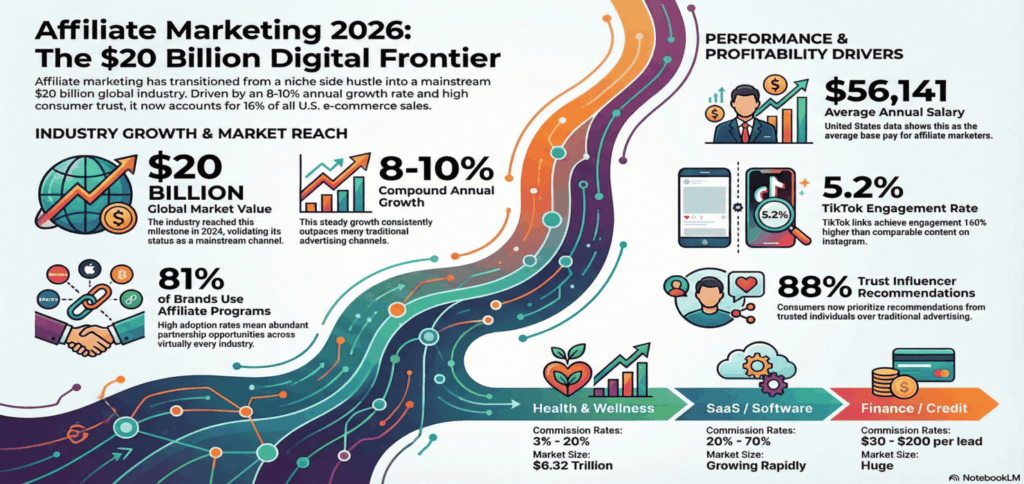
According to Astute Analytica, the global affiliate marketing industry reached a valuation of over $20 billion in 2024. This represents significant growth from previous years and demonstrates the increasing reliance of businesses on performance-based marketing strategies.
What This Means: The affiliate marketing industry is no longer a niche strategy but a mainstream revenue channel for both established brands and digital-first companies. This market size validates affiliate marketing as a viable career path and business model.
2. Market Projected to Reach $31-40 Billion by 2031
Industry projections from Astute Analytica and Publift suggest the global affiliate marketing market will nearly double over the next 5-7 years, reaching between $31 billion and $40 billion by 2031.
What This Means: Early movers in emerging affiliate niches and platforms have significant growth opportunity ahead. The market expansion indicates more brands will adopt affiliate programs, creating more partnership opportunities.
3. Industry Growing at 8-10% CAGR
The affiliate marketing industry is experiencing a compound annual growth rate (CAGR) of 8-10%, significantly outpacing many traditional advertising channels. This steady growth has been consistent since 2015 and shows no signs of slowing.
What This Means: Unlike volatile marketing trends, affiliate marketing offers sustainable, predictable growth. This makes it attractive for long-term business planning and career development.
4. US Affiliate Spending to Reach $16 Billion by 2028
In the United States alone, affiliate marketing spending is projected to approach $16 billion by 2028. North America currently accounts for over 40% of global affiliate marketing revenue, making it the largest regional market.
What This Means: The US market remains the most lucrative for affiliate marketers, though competition is also highest. Focusing on underserved niches or regional markets within the US can provide competitive advantages.
5. Over 80% of Brands Use Affiliate Marketing Programs
Research by Rakuten and Forrester reveals that 81% of advertisers and 84% of publishers now utilize affiliate marketing programs. This widespread adoption indicates that affiliate marketing has become a standard component of digital marketing strategies.
What This Means: With such high adoption rates, affiliate marketers have abundant partnership opportunities across virtually every industry. However, standing out among other affiliates requires differentiation through content quality, audience trust, or unique positioning.
6. Affiliate Marketing Drives 16% of US E-Commerce Sales
Affiliate marketing accounts for 16% of all e-commerce sales in the United States and Canada, making it one of the most significant drivers of online revenue. This contribution rivals other major marketing channels like paid search and email marketing.
What This Means: E-commerce brands that aren’t leveraging affiliate partnerships are missing out on significant revenue. For affiliates, this statistic validates the effectiveness of product-focused content and review sites.
Platform Performance & Traffic Statistics
7. Amazon Associates Commands 46.11% Market Share
Amazon Associates remains the dominant affiliate program globally, holding 46.11% of the affiliate marketing market share. The next largest networks—Rakuten (7.78%), Awin (6.68%), ShareASale (6.46%), and CJ Affiliate (6.24%)—collectively control less than 30% of the market.
What This Means: Amazon’s dominance offers ease of entry and product variety, but commission rates (typically 1-10%) are lower than specialized affiliate programs. Successful affiliates often use Amazon as one component of a diversified monetization strategy.
8. Mobile Devices Account for 50-62% of Affiliate Traffic
Mobile traffic now represents 50-62% of all affiliate-driven visits, depending on niche and audience. This mobile-first reality has fundamentally changed how affiliates must design their content and optimize conversion paths.
What This Means: Affiliate sites that aren’t mobile-optimized are losing over half their potential conversions. Fast load times, responsive design, and mobile-friendly CTAs are no longer optional—they’re essential for success.
9. SEO Remains Top Traffic Source for 69% of Affiliates
Despite the rise of social media, search engine optimization remains the primary traffic source for 69% of affiliate marketers. Social media follows at 67%, blogging at 65%, and paid advertising (PPC) at 34%.
What This Means: Long-term affiliate success still relies heavily on ranking in search results. While social media can provide quick wins, sustainable affiliate businesses invest in SEO for consistent, compounding traffic growth.
10. TikTok Affiliate Links See 5.2% Engagement Rate
TikTok has emerged as a powerhouse for affiliate marketing, with affiliate links achieving a 5.2% engagement rate—160% higher than comparable content on Instagram. TikTok creators with 50,000 or fewer followers see engagement rates as high as 30.1%, which is 1,570% higher than similar-sized influencers on Instagram.
What This Means: Short-form video platforms like TikTok and YouTube Shorts are becoming essential channels for affiliate marketers, especially those targeting younger demographics. Authentic, entertaining product demonstrations consistently outperform traditional review content.
11. Social Commerce Revenue to Exceed $1 Trillion by 2028
Social commerce—the integration of e-commerce directly into social media platforms—is projected to generate over $1 trillion in revenue by 2028. This includes in-app purchases on Instagram, TikTok Shop, Facebook Marketplace, and Pinterest Shopping.
What This Means: The line between social media and e-commerce is disappearing. Affiliates who master shoppable content and platform-native commerce features will capture a larger share of impulse purchases and social-driven sales.
12. Email Marketing Delivers $36 ROI per $1 Spent
Email remains one of the highest-ROI channels for affiliate marketing, generating an average return of $36 for every dollar spent. Behavior-based automated email sequences perform even better, with 8 times more opens than bulk emails.
What This Means: Building an email list should be a priority for every affiliate marketer. The ability to directly reach interested subscribers creates a sustainable, algorithm-independent traffic source that typically converts 2-3x higher than cold traffic.
Platform Performance Comparison
| Platform | Engagement | Best For | Difficulty |
| TikTok Shop | 5.2% | Gen Z, Fashion, Beauty | Medium |
| YouTube | 4.1% | Tech, Reviews, Tutorials | High |
| 3.2% | Lifestyle, Travel, Fitness | Medium | |
| 2.8% | High-Ticket, B2B, SaaS | Low | |
| SEO/Blog | 1.5-3% | All Niches, Evergreen | High |
Note: Engagement rates vary significantly based on niche, audience quality, and content type. These are industry averages.
Niche & Industry Statistics
13. Health & Wellness Is the Most Profitable Niche
The health and wellness industry represents a $6.32 trillion global market, making it the most lucrative niche for affiliate marketers. Within this sector, the fitness segment alone is projected to reach $6.73 billion by 2027, growing at 9.61% annually. Commission rates in this niche typically range from 3% to 20%.
What This Means: The broad appeal of health and wellness creates opportunities across multiple sub-niches: supplements, fitness equipment, meal planning, workout programs, and wellness apps. However, competition is fierce and regulatory compliance (especially for health claims) is critical.
14. SaaS Products Offer 20-70% Commission Rates
Software as a Service (SaaS) affiliate programs offer some of the highest commission rates in the industry, ranging from 20% to 70% depending on the product and pricing tier. Many SaaS programs also offer recurring commissions, providing ongoing income from a single referral.
What This Means: SaaS affiliates can build substantial recurring income streams. A single referral to a $99/month product at 30% commission generates $29.70 monthly—potentially for years. The challenge is that SaaS requires more sophisticated selling through tutorials, comparisons, and demonstrations.
15. Retail Dominates Affiliate Spend at 48%
Retail accounts for 48% of total affiliate marketing spending in major markets like the UK. Following retail, telecommunications contributes 19%, travel and hospitality 13%, and finance/banking 8% of affiliate revenue.
What This Means: While retail offers the most opportunities, the high concentration also means intense competition. Affiliates might find better success in underserved categories like telecommunications or finance, where higher customer lifetime values support more generous commissions.
Top Affiliate Marketing Niches Comparison
| Niche | Commission | Competition | Market Size |
| Health & Wellness | 3-20% | Very High | $6.32T |
| SaaS/Software | 20-70% | High | Growing |
| Finance/Credit | $30-200/lead | Very High | Huge |
| Fashion/Beauty | 5-15% | Very High | Large |
| Web Hosting | $65-130/sale | High | Medium |
| Travel | 3-10% | High | Large |
Income & Earnings Statistics
16. Average Affiliate Marketer Salary: $56,141 Annually
According to PayScale data from December 2025, affiliate marketers in the United States earn an average base salary of $56,141 per year. This figure varies significantly based on experience, niche selection, traffic levels, and business model.
What This Means: This average includes both part-time and full-time affiliate marketers. Top performers earn $100K+, while many beginners earn little to nothing in their first 6-12 months. Median income is likely closer to $35K-40K, with the average pulled upward by high earners.
17. Businesses Earn $6.50-$15 per $1 Spent on Affiliate Marketing
From the business perspective, affiliate marketing delivers exceptional ROI. Companies typically earn between $6.50 and $15 for every dollar spent on affiliate commissions and program management. Some email-driven campaigns report ROAS (Return on Ad Spend) as high as 14:1, demonstrating affiliate marketing’s profit potential.
What This Means: This high ROI explains why over 80% of brands now use affiliate programs. For affiliates, it validates that you’re providing genuine value—brands wouldn’t pay these commissions if the economics didn’t work.
18. Top Fitness Affiliates Earn $7,000+ Monthly
Within the fitness niche specifically, successful affiliate marketers report monthly earnings exceeding $7,000. This comes from promoting a mix of fitness equipment, supplements, workout programs, and training certifications with commission rates between 3% and 20%.
What This Means: Niche specialization can significantly boost earnings. While general product affiliates may struggle with 1-3% Amazon commissions, niche-focused affiliates access premium programs with higher rates and more engaged audiences willing to purchase.
19. Bluehost Paid Over $5M in Commissions Annually
Web hosting company Bluehost reportedly pays over $5 million annually to its affiliate partners. Individual affiliates can earn $65-$130 per sale, making web hosting one of the most lucrative affiliate niches for tech-focused content creators.
What This Means: High-ticket affiliate programs can be game-changers for monetization. A single Bluehost sale provides more commission than dozens of Amazon purchases. However, these require more sophisticated selling through tutorials, comparisons, and trust-building.
20. Affiliates Aged 35-44 Comprise 32% of the Industry
The largest demographic in affiliate marketing is the 35-44 age group, representing 32% of all affiliate marketers. This age group also tends to have the highest success rate, likely due to a combination of professional experience, established networks, and financial resources to invest in their businesses. The 25-34 age group follows at 24%, while those 45-54 represent only 10%.
What This Means: Affiliate marketing success often correlates with professional maturity. The 35-44 demographic brings industry expertise, audience understanding, and patience for long-term strategy—all critical for building sustainable affiliate income.
Consumer Behavior & Trust Statistics
21. 88% of Consumers Purchase Based on Influencer Recommendations
According to Nielsen’s Trust in Advertising research, 88% of consumers have made purchase decisions based on influencer recommendations. This represents a fundamental shift in how purchasing decisions are made, with trusted individuals often carrying more weight than traditional advertising.
What This Means: Building trust and authority in your niche is essential for affiliate success. Audiences don’t just want product links—they want genuine recommendations from sources they trust. This is why personal branding and authentic content consistently outperform generic affiliate sites.
22. 9 in 10 Consumers Trust Online Reviews
90% of consumers say online reviews influence their buying decisions. This makes review content one of the most effective formats for affiliate marketing, whether through written reviews, video demonstrations, or comparison articles.
What This Means: Comprehensive, honest review content is your competitive advantage. Affiliates who invest time in thorough product testing, balanced pros/cons analysis, and real user experiences build credibility that translates directly to higher conversion rates.
23. User-Generated Content Trusted by 92% of Consumers
User-generated content (UGC)—customer reviews, testimonials, unboxing videos, and social media posts—is trusted by 92% of consumers, significantly more than traditional advertising. Marketing campaigns featuring UGC see a 29% increase in web conversions compared to campaigns without it.
What This Means: Encouraging and showcasing customer experiences amplifies your affiliate marketing effectiveness. Real stories from real people create social proof that polished marketing can’t replicate. Consider building community features or customer showcase sections into your content strategy.
24. 41% of Gen Z Trust Influencer Products Over Traditional Ads
Among Gen Z consumers specifically, 41% report trusting products endorsed by influencers more than traditional advertising. This trust extends to micro-influencers and niche content creators, not just celebrity endorsements. Additionally, 40% of consumers overall have purchased products directly after seeing an influencer post.
What This Means: Younger demographics particularly value authentic, personal recommendations. If your target audience skews younger, influencer-style content (first-person experiences, behind-the-scenes, transparent partnerships) will likely outperform formal review formats.
Technology & Emerging Trends
25. AI Marketing Market Valued at $20.45B, Growing 25% Annually
The AI in marketing sector reached $20.45 billion in 2024 and is projected to grow at 25% CAGR through 2030. For affiliate marketers, this means increased access to AI-powered tools for content creation, analytics, personalization, and fraud detection.
What This Means: AI tools are becoming essential for competitive affiliate marketing. From AI-generated product descriptions and SEO optimization to predictive analytics and automated email sequences, affiliates who leverage AI can scale their operations significantly. However, maintaining authentic human perspective remains crucial for trust.
26. 81% of Consumers Prefer Personalized Experiences
81% of consumers prefer brands that offer personalized experiences tailored to their preferences and behavior. AI-powered personalization is making this level of customization accessible to affiliate marketers through dynamic content, personalized product recommendations, and behavioral email triggers.
What This Means: Generic affiliate content is losing effectiveness. Successful affiliates are implementing personalization through segmented email lists, dynamic landing pages, and tailored product recommendations based on user behavior and preferences.
27. Affiliate Fraud Accounts for 17% of Traffic, $3.4B in Losses
In 2022, fraudulent clicks represented 17% of all affiliate traffic, resulting in approximately $3.4 billion in losses for advertisers. Common fraud types include click fraud, cookie stuffing, and bot-generated fake conversions. AI-powered fraud detection tools are becoming essential for protecting both advertisers and legitimate affiliates.
What This Means: Legitimate affiliates should expect increased scrutiny and verification requirements from affiliate programs. Building transparent relationships with merchants, maintaining detailed traffic logs, and using fraud prevention tools protects your reputation and ensures you receive proper commission attribution.
28. 93% of Marketers Prioritize First-Party Data
With third-party cookies being phased out, 93% of marketers now consider first-party data collection more important than ever. This shift is forcing affiliate marketers to build owned audiences through email lists, community platforms, and direct customer relationships rather than relying solely on paid traffic or third-party platforms.
What This Means: Email list building and community development are no longer optional—they’re survival strategies. Affiliates who own their audience data will weather privacy regulation changes and platform algorithm updates far better than those dependent on rental traffic.
29. Search Interest in ‘Affiliate Marketing’ Doubled Since 2016
Google Trends data shows search interest in the term ‘affiliate marketing’ has more than doubled since 2016, with a significant surge from 2020 onward. Interest peaked at 100 (the highest possible score) in July 2023, likely driven by increased online business activity during and after the COVID-19 pandemic.
What This Means: Rising interest brings both opportunity and competition. More people entering affiliate marketing means more tools, education, and innovation in the space. However, it also means established niches become more competitive, rewarding affiliates who can differentiate through specialized expertise or unique audience access.
30. Programmatic Advertising Accounts for 72% of Digital Display Ads
Programmatic advertising now represents 72% of all digital display advertising. This automated, AI-driven ad buying is increasingly being integrated with affiliate marketing strategies, allowing more precise targeting and real-time optimization of affiliate promotions.
What This Means: The line between affiliate marketing and programmatic advertising is blurring. Affiliates who understand how to leverage programmatic platforms for audience targeting and retargeting can significantly improve conversion rates, especially for higher-priced products requiring multiple touchpoints.
31. 21% of Affiliates Report Best ROI from Short-Form Video
21% of affiliate marketers now identify TikTok and YouTube Shorts as their highest ROI channels. Short-form video’s authentic, entertaining format aligns perfectly with how younger audiences discover and evaluate products, making it one of the fastest-growing affiliate marketing channels.
What This Means: If you’re not experimenting with short-form video, you’re missing significant opportunity—especially for products targeting Gen Z and younger Millennials. The barrier to entry is low, and authentic product demonstrations often outperform highly produced content.
Payment Models & Operational Statistics
32. 99% of Programs Use Cost-Per-Action (CPA) Payment Model
The overwhelming majority—99%—of affiliate programs use the CPA (Cost Per Action) payment model, where affiliates earn commission only when a specific action occurs, typically a sale. Other payment models like CPC (Cost Per Click) and CPL (Cost Per Lead) exist but are far less common in mainstream affiliate marketing.
What This Means: Your income directly correlates with your ability to drive actual sales or conversions, not just traffic. This makes conversion rate optimization, audience targeting, and trust-building absolutely critical. Traffic volume matters less than traffic quality and relevance.
33. Only 7% of Marketing Managers Make Affiliate a Top Priority
Despite affiliate marketing’s proven ROI, only 7% of marketing managers rank it as their top budget priority, according to Forrester’s 2024 report. However, this is changing as more companies recognize the value of performance-based marketing, with 50%+ of UK brands planning to increase affiliate investments in 2026.
What This Means: Affiliate marketing is still growing into its potential. For affiliates, this represents opportunity—many brands are expanding their programs and actively recruiting quality partners. Positioning yourself as a professional, data-driven affiliate can open doors to premium partnerships.
34. 83% of Brands Recruit Affiliates Through Network Dashboards
83% of affiliate recruiters discover new partners through affiliate network dashboards like ShareASale, CJ Affiliate, Rakuten, and Awin. This makes having well-optimized profiles on major networks essential for being discovered by brands seeking affiliates.
What This Means: Your affiliate network profiles are your business storefront. Complete profiles with detailed audience demographics, traffic statistics, and content examples significantly increase your chances of being recruited for premium programs with higher commissions.
Regional Growth & Emerging Markets
35. Latin America E-Commerce Growing at 20% CAGR
Latin America’s e-commerce market is projected to grow at an estimated 20% compound annual growth rate from 2023 to 2027, creating significant opportunities for affiliate marketers. This growth is driven by increasing internet penetration, mobile adoption, and a growing middle class.
What This Means: Early movers in emerging markets can establish authority before competition intensifies. Affiliates who speak Spanish/Portuguese or understand regional nuances have particular advantage in these high-growth markets.
36. Asia-Pacific to Account for 40% of Global Retail by 2028
The Asia-Pacific region is set to account for 40% of global retail sales by 2028, up from 37% in 2023. This represents the fastest-growing market for affiliate marketing globally, with particular strength in mobile commerce and social shopping platforms.
What This Means: Western-focused affiliates should consider how to access or understand Asian markets, either directly or through partnerships. The sheer market size and digital adoption rates make this region impossible to ignore for long-term growth.
37. UK Affiliate Spending Increased 17% Year-Over-Year
Affiliate marketing expenditure in the United Kingdom increased by 17% from 2022 to 2023, with over 50% of brands planning to boost their affiliate investments in 2026. The UK represents one of the most mature and sophisticated affiliate markets globally.
What This Means: Established markets like the UK offer stability and sophisticated infrastructure but require professional execution. Success in mature markets depends on specialization, audience quality, and demonstrable ROI for merchant partners.
Key Takeaways & Action Steps
The affiliate marketing landscape in 2026 is defined by robust growth, technological innovation, and evolving consumer expectations. Based on these 37+ statistics, here are the most critical insights:
Top 5 Strategic Takeaways
- The industry is growing steadily at 8-10% annually with projections to reach $31-40 billion by 2031. This validates affiliate marketing as a long-term career and business opportunity, not a passing trend.
- Platform diversification is essential. While SEO remains important (69% of affiliates), emerging platforms like TikTok (5.2% engagement) and the shift to social commerce ($1T by 2028) require multi-channel strategies.
- Niche selection dramatically impacts earnings. Health/wellness ($6.32T market) and SaaS (20-70% commissions) offer premium opportunities, while competitive niches require sophisticated differentiation.
- Trust and authenticity drive conversions. With 88% of consumers purchasing based on influencer recommendations and 92% trusting UGC, building genuine audience relationships matters more than ever.
- Technology adoption is becoming non-negotiable. AI tools ($20.45B market), mobile optimization (50-62% of traffic), and first-party data strategies (93% prioritize this) separate successful affiliates from struggling ones.
Next Steps for Aspiring & Established Affiliates
For Beginners:
- Choose a specific niche based on both profitability data and genuine interest
- Start building your email list from day one (93% prioritize first-party data)
- Focus on one primary traffic source (SEO or social) rather than spreading thin
- Set realistic income expectations: average is $56K annually, but most earn less in year one
For Established Affiliates:
- Experiment with short-form video (21% report best ROI from TikTok/YouTube Shorts)
- Diversify beyond Amazon (46% market share but low commissions) into specialized programs
- Implement AI-powered personalization tools (81% of consumers prefer personalized experiences)
- Consider expanding into emerging markets (Latin America 20% CAGR, Asia-Pacific 40% of retail)
The Future of Affiliate Marketing
The affiliate marketing industry stands at an inflection point. While the fundamentals—trust-based recommendations driving purchase decisions—remain unchanged, the mechanics are evolving rapidly. AI is automating operational tasks while raising expectations for personalization. Privacy regulations are forcing a return to owned audiences and direct relationships. Social commerce is creating new conversion pathways that bypass traditional websites entirely.
Success in this environment requires balancing timeless principles (audience trust, genuine value, quality content) with emerging capabilities (AI tools, short-form video, social commerce, programmatic targeting). The affiliates who thrive will be those who build sustainable businesses grounded in authentic audience relationships while staying agile enough to adopt new technologies and platforms as they emerge.
The data is clear: affiliate marketing is growing, professionalizing, and offering unprecedented opportunities for those willing to approach it strategically. Whether you’re just starting or scaling an established operation, these statistics should inform—but not dictate—your strategy. Test, measure, iterate, and build the affiliate business that aligns with your goals, strengths, and market opportunities.
Frequently Asked Questions
How much do most affiliate marketers actually make?
The average affiliate marketer salary is $56,141 annually according to PayScale, but this varies dramatically. Many beginners earn little to nothing in their first 6-12 months, while top performers in lucrative niches (SaaS, finance, health) can earn $100K+ annually. Median income is likely $35K-40K, with the average pulled higher by top earners.
What is the most profitable affiliate marketing niche?
Health and wellness is the most profitable niche by market size ($6.32 trillion globally), with fitness alone projected to reach $6.73 billion by 2027. However, SaaS products offer the highest commission rates (20-70%) and often include recurring payments. The ‘best’ niche depends on your expertise, audience, and ability to compete effectively.
Is affiliate marketing still worth it in 2026?
Yes, with the industry growing at 8-10% CAGR and projected to reach $31-40 billion by 2031. Over 80% of brands now use affiliate programs, creating abundant partnership opportunities. However, competition has increased significantly, making niche specialization, quality content, and audience trust more important than ever for success.
How long does it take to make money with affiliate marketing?
Most affiliates require 6-12 months before earning meaningful income. SEO-based strategies typically take longer (8-18 months to build traffic) but offer more sustainable results. Social media and paid advertising can generate faster results (2-6 months) but require ongoing effort. The 35-44 age demographic shows highest success rates, suggesting experience and patience matter significantly.
What platforms are best for affiliate marketing in 2026?
TikTok shows the highest engagement rates (5.2%, 160% higher than Instagram), making it excellent for product-focused content. SEO remains the top traffic source for 69% of affiliates, offering sustainable long-term traffic. Email marketing delivers the best ROI at $36 per $1 spent. The most successful affiliates use multiple platforms strategically rather than relying on a single channel.
How do I start affiliate marketing with no money?
Start with free platforms: create content on Medium, YouTube, TikTok, or Pinterest. Join free affiliate networks like Amazon Associates, ShareASale, or CJ Affiliate. Focus on SEO for organic traffic rather than paid advertising. As you earn commissions, reinvest in premium tools, hosting, and content creation. Many successful affiliates started with zero budget, though growth is typically slower without investment.
Sources & Research Citations
This article synthesizes data from the following authoritative sources:
- Astute Analytica – Global Affiliate Marketing Market Research
- Forrester Research – Affiliate Marketing Industry Reports
- Rakuten Advertising – State of Affiliate Marketing
- Statista – E-commerce and Affiliate Marketing Statistics
- Nielsen – Trust in Advertising Research
- PayScale – Affiliate Marketer Salary Data (December 2025)
- Google Trends – Search Interest Data
- Influencer Marketing Hub – Industry Benchmarks
- Publift – Affiliate Marketing Statistics and Trends
- Business of Apps – Social Commerce Research
- eMarketer – Digital Advertising Trends
All statistics were verified and cross-referenced across multiple sources where possible to ensure accuracy. Market projections represent consensus estimates from leading research firms.










Add a Comment