
150+ Best Email Subject Lines: Examples That Actually Get Opened (2026)
Last updated on
by
If your subject line is weak, then subscribers will likely skip your email, delete it, or report it as spam. According to Invesp, 47% of email recipients open email based on the subject line, and 69% report email as spam based solely on the subject line.
So, it’s worth spending a few extra minutes on the subject line before you hit send. In this guide, I’ll show you 150+ email subject line examples sorted by type, from sales and FOMO to follow-ups and re-engagement, plus the formulas behind them.
For more numbers, see our guide to email subject line statistics.
- What Makes a Great Email Subject Line?
- How to Pair Your Subject Line With Preview Text
- Six Subject Line Formulas That Increase Opens
- FOMO Email Subject Lines
- Curiosity-Inducing Email Subject Lines
- Funny Email Subject Lines
- Professional Email Subject Lines
- Catchy Email Subject Lines
- Personalized Email Subject Lines
- Pain Point Email Subject Lines
- Sales Email Subject Lines
- Welcome Email Subject Lines
- Thank You Email Subject Lines
- Review and Survey Request Email Subject Lines
- Event Email Subject Lines
- Follow-Up Email Subject Lines
- Re-Engagement Email Subject Lines
- Cold Email Subject Lines
- Newsletter Subject Lines
- Holiday and Black Friday Email Subject Lines
- Words and Phrases That Boost Open Rates
- Email Subject Line Mistakes to Avoid
- Frequently Asked Questions About Email Subject Lines
- Start Growing Your Email List
What Makes a Great Email Subject Line?
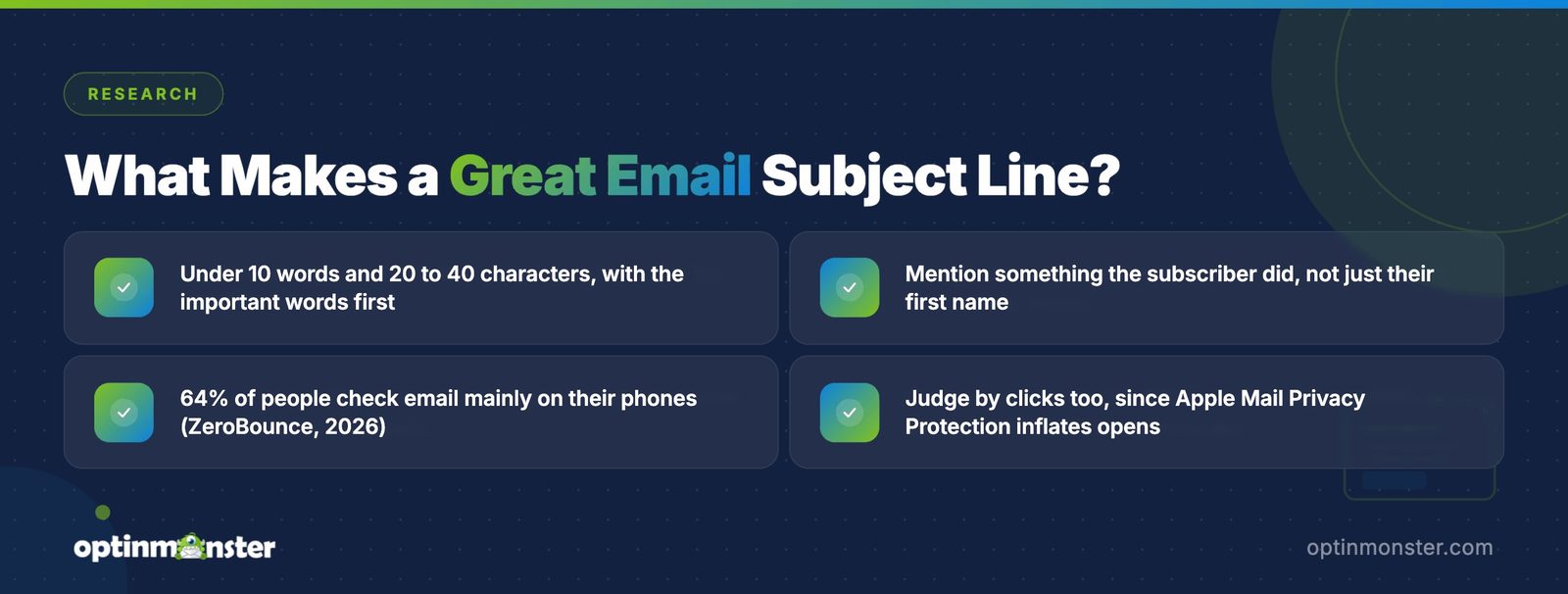
A great email subject line is short enough to read in full on a phone, specific about what’s inside, and relevant to the person who receives it.
Here are four things to get right in a subject line, and how to tell whether it worked:
- Length: I recommend staying under 10 words and between 20 and 40 characters. Learn more in our guide to email subject line length.
- Mobile: ZeroBounce’s 2026 email statistics survey found that 64% of people check email mainly on their phones. So, make sure the words that matter come first, before a phone inbox cuts the line off.
- Relevance: If you mention something the subscriber did, like a recent purchase or a guide they downloaded, then they can tell the email is about them. So, if you have that detail, then use it before you reach for their first name.
- Measurement: Mail Privacy Protection makes open counts look higher than they are. In Litmus’s email client market share data, Apple accounts for 62.26% of tracked opens, and that share includes Mail Privacy Protection opens.
For more on writing subject lines, see our guide to email subject line best practices.
How to Pair Your Subject Line With Preview Text
Preview text, also called preheader text, is the short line that most inboxes show beside or below the subject line. Subscribers usually see the two together when they decide whether to open the email.
So, you get a second chance in the preview text to say why the email is worth opening.
I recommend writing the preview text at the same time as the subject line. If you write them together, then you can use the preview text to add a detail the subject line leaves out.
I’ll show you three pairings, each giving the preview text a different job:
- Add the next step: “Your free trial ends tomorrow” with the preview text “Choose a plan to keep everything you’ve set up.”
- Add the specifics: “The checklist you asked for” with the preview text “12 quick fixes to try on your signup form this week.”
- Answer the follow-up question: “We’re closed on Monday” with the preview text “Orders placed by Friday at noon still ship this week.”
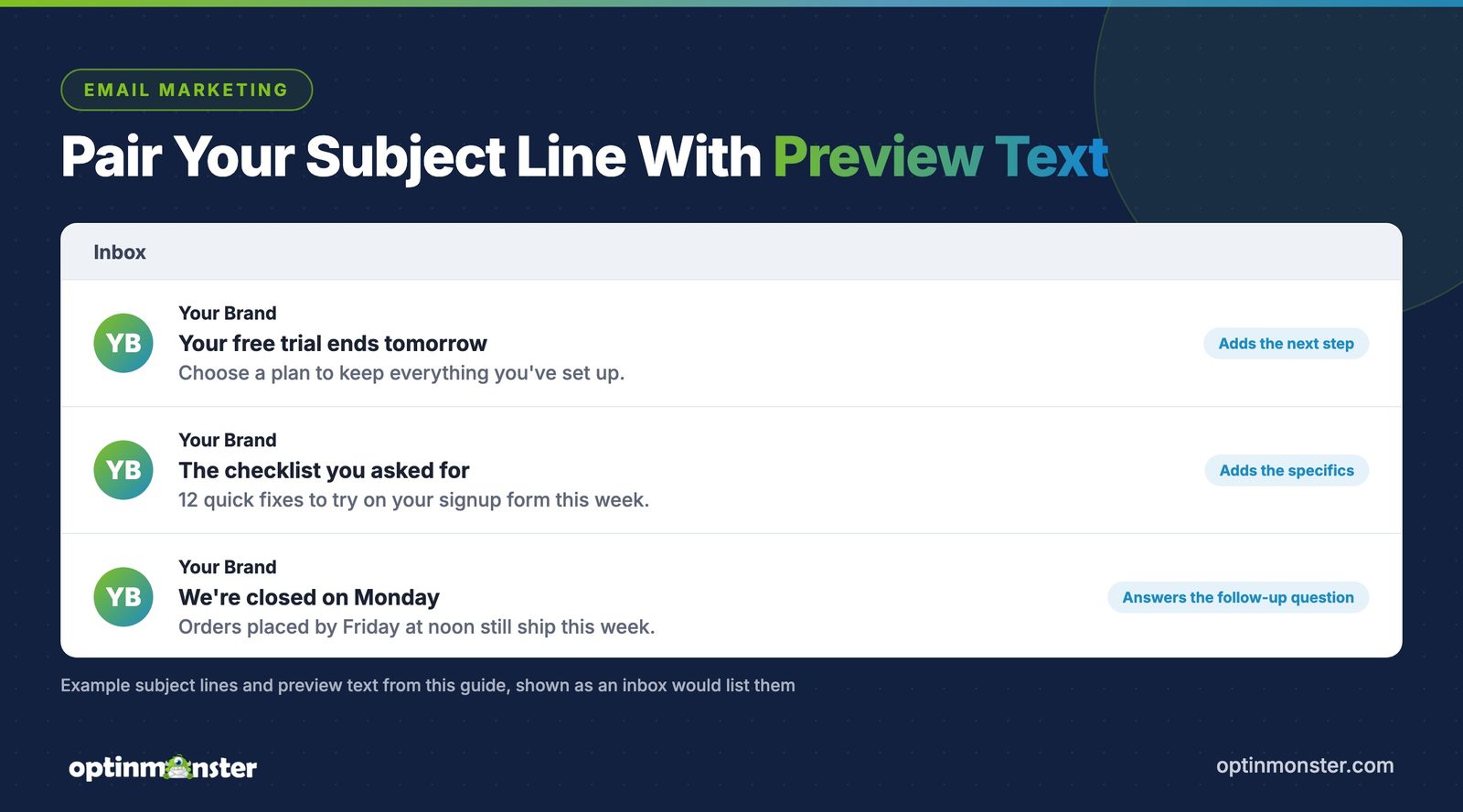
Before you schedule the send, email a test to yourself from your email marketing service and read the pair on your phone. You’ll see where each inbox cuts the line off.
Six Subject Line Formulas That Increase Opens
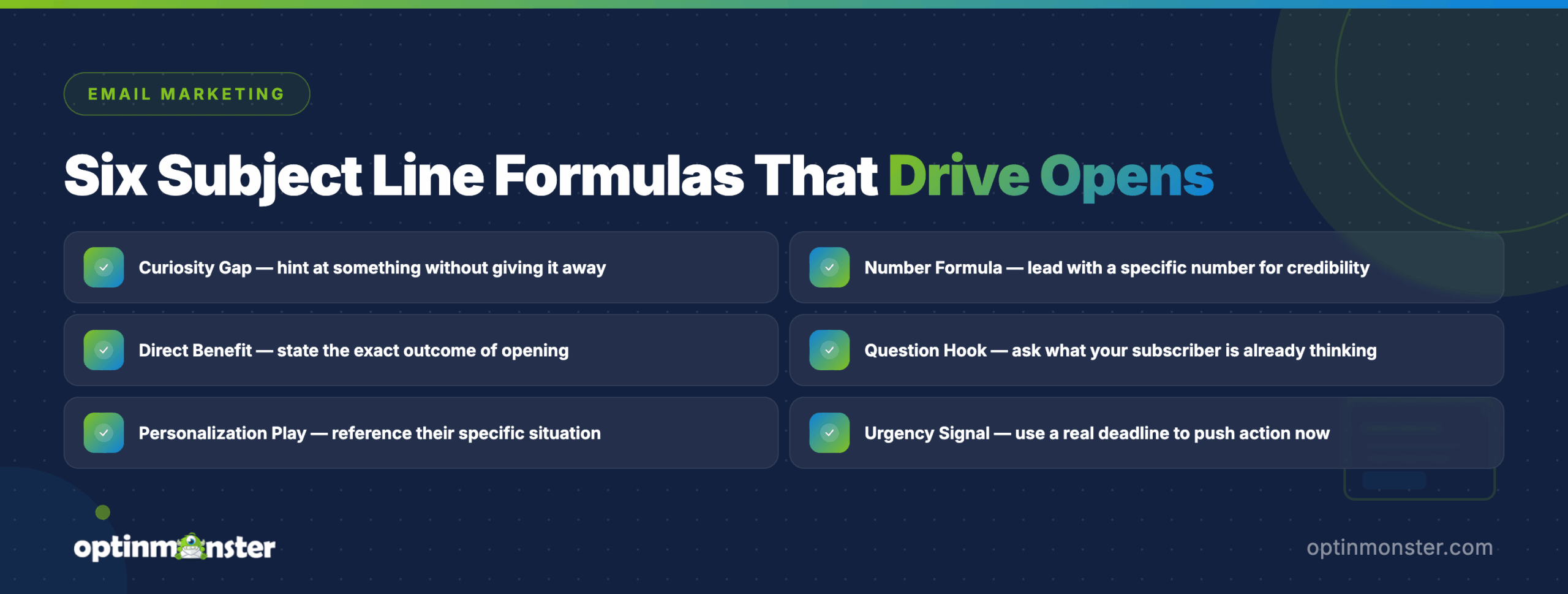
A lot of the subject lines on this page use one of six formulas. Once you can spot the formula behind a line, you can reuse it in your own campaigns.
Here are the main ones:
| Formula | How it works | Example |
|---|---|---|
| The Curiosity Gap | You hint at something interesting and hold back the details. Subscribers have to open the email to find out what it is. | “We found something surprising in your data” |
| The Number Formula | You lead with a specific number. This means people know exactly what they’ll get before they open. | “7 subject lines that doubled our open rate” |
| The Direct Benefit | You state the exact outcome the reader gets by opening. So, nobody has to guess what’s inside. | “How to double your email list in 30 days” |
| The Question Hook | You ask the question your subscriber is already asking themselves. Then they may open the email to get the answer. | “Are you making this email marketing mistake?” |
| The Personalization Play | You mention something specific about the person, like their name or a recent download. So, they’re more likely to spot it in a busy inbox. | “[First name], your guide is ready” |
| The Urgency Signal | You give readers a deadline. So, they have a reason to open today. | “Last day: 40% off ends at midnight” |
You’ll see these formulas in many of the categories below.
The funny lines are the main exception. They’re jokes, not formulas.
When you like a subject line, then try to name its formula. Then swap in your own offer, number, or deadline.
FOMO Email Subject Lines
With FOMO (fear of missing out) subject lines, subscribers get to see what they could miss if they wait. When an offer ends soon, then subscribers can’t save your email for later.
But manufactured urgency can destroy trust fast. Subscribers who catch a fake deadline may stop believing the next one.
So, make the deadline real, and fill each bracket with the details of your own offer. Here are some to start from:
- “This deal disappears in three hours”
- “Only 11 spots left — claim yours”
- “Last chance: your discount expires tonight”
- “You’re about to miss this”
- “We’re closing enrollment at midnight”
- “48 hours left to lock in your price”
- “Your invitation expires tomorrow”
- “Sale ends [day] at [time and time zone]”
- “[X] subscribers claimed their discount this morning”
- “This is the last time we’re offering this”
- “Your free trial ends in 24 hours”
- “[X]% of the early-bird seats are gone”
Curiosity-Inducing Email Subject Lines
With these email subject lines, you hint at something and hold back the answer. So, curious readers tend to open the email to find out.
Try them when you want people to open the email but don’t want to give away the offer in the subject line.
Here are some examples:
- “The weird thing behind our highest-converting page”
- “I wasn’t going to share this”
- “Here’s what we found when we actually tested it”
- “What happened when we cut our onboarding emails in half”
- “You might not want to hear this about your unsubscribe rate”
- “Something unexpected just happened with our results”
- “The one question you should ask before every send”
- “We almost didn’t tell you about this”
- “What nobody tells you about email marketing”
- “We ran the numbers. The results were surprising.”
Funny Email Subject Lines
Subscribers tend to notice a funny subject line in a crowded inbox. This is because most of them don’t expect a joke from a brand.
But the joke only works when the tone matches your brand. So, make sure your readers would expect a laugh from you before you go this route.
It also helps to check that each joke still names what’s inside. If subscribers can’t tell what the email is about, then they have little reason to open it.
- “We messed up. Here’s how you benefit.”
- “This email is 99% less boring than your last meeting”
- “Sorry, this isn’t a cat video. But it’s close.”
- “Shocking: a pricing email you might actually enjoy”
- “We tried to write a boring subject line. We failed.”
- “You have better things to do. This takes two minutes.”
- “It’s Monday. Please accept this coupon as an apology.”
- “Your inbox called. It wants something good.”
- “We bribed our team with coffee to make this for you”
- “Plot twist: the villain was your abandoned cart all along”
Professional Email Subject Lines
These subject lines work for outreach, workplace communication, and formal follow-ups.
At work, you want the person to read your email and take it seriously. So, a good professional subject line names the topic, or what you need from them.
I’ve grouped the examples by situation. Jump to the one you’re writing in.
Business Outreach
- “Quick question about [project or topic]”
- “Following up on our conversation from [day]”
- “Introduction: [Your Name] from [Company]”
- “Meeting request: 20 minutes this week?”
- “Checking in — any updates on [topic]?”
- “Proposal for [Project Name] — attached”
- “Action required: please review by [date]”
Meetings and Calendar
- “Confirming our call on [day] at [time]”
- “Can we reschedule to Thursday?”
- “Agenda for [Meeting Name] on [Date]”
- “Reminder: [Meeting Name] starts in one hour”
- “Notes from today’s meeting — see below”
Professional Follow-Up
- “Still interested? Happy to answer any questions”
- “Re: [Topic] — one more thought”
- “Confirming the [date] deadline for [project]”
- “Touching base from our call last week”
- “Just wanted to make sure this didn’t get buried”
Formal and Report-Based
- “Q1 performance summary — ready for your review”
- “Update: [Project Name] status as of [Date]”
- “New policy effective [Date] — please read”
- “Your invoice from [Company] is ready”
- “Contract sent — please review at your convenience”
Networking
- “Great meeting you at [Event Name]”
- “Could you introduce me to [Name] at [Company]?”
- “A quick favor — takes two minutes”
Catchy Email Subject Lines
Subscribers often open a catchy subject line for a bold claim, a useful promise, or a bit of personality. You don’t need a countdown timer or a cliffhanger to get there.
These subject lines work well for brand-building emails, when you’d rather build a habit of opening than ask for a sale.
So, I’d save them for emails you want subscribers to keep opening week after week, like your regular newsletter or a story about how you built a product.
- “The email you’ll actually want to open”
- “The [product] shortcut our team uses every day”
- “The [product] our customers keep reordering”
- “Your subscribers want this — are you giving it to them?”
- “The subject line that outperformed all the others”
- “We rewrote our homepage. Here’s what we learned.”
- “Everything you think you know about [topic] is wrong”
- “The one change that transformed our email list”
- “Why your best emails are being ignored”
- “Email marketing in [Year]: what actually works”
Personalized Email Subject Lines
I’ll show you ten personalized subject lines below, and most of them include a spot in square brackets.
Make sure to fill that spot with something that the subscriber did on your website. That could be a product they viewed, a guide they downloaded, or an order they placed.
Your email marketing service may already store that activity as tags or custom fields. If it doesn’t, then you can collect the detail when people sign up.
This is where OptinMonster, our own tool, comes in. You can add a Dropdown or Radio Button field to an OptinMonster signup form, with a question like “Which topic do you want tips on?”
Then field mapping sends each answer to a custom field in your email marketing service. So, a subscriber who picks running shoes could get “[First name], new running shoes just landed.”
I’d keep it to one question, so the form still feels quick. Some email marketing services need you to create the custom field first, and our field mapping guide walks through it.
- “[First name], here’s your personalized recommendation”
- “You left something behind, [First name]”
- “Based on your recent visit — we picked these for you”
- “Happy [anniversary or birthday], [First name]. Here’s a gift.”
- “You downloaded [Resource] — here’s the next step”
- “[First name], the [product] you viewed is back in stock”
- “We noticed you haven’t tried this feature yet”
- “A follow-up on your recent [purchase or action]”
- “You’re almost at [milestone]. Here’s what’s next.”
- “Since you liked [previous content], you’ll love this”
Pain Point Email Subject Lines
Pain point subject lines name a frustration your subscriber already has. When someone reads a subject line and thinks “that’s exactly my problem,” then they have a clear reason to open the email and see what you suggest.
For your own lines, you could borrow the words your subscribers use in replies, reviews, or support tickets. The first three lines below are templates to fill in, and the next two are filled examples from other kinds of businesses.
- “Tired of [pain]? Start here”
- “Why your [effort] isn’t paying off yet”
- “The [pain] fix most [audience] overlook”
- “Why your sourdough keeps coming out flat”
- “Out of money before payday? Try this budget”
- “Getting traffic but not enough sales? Read this.”
- “What to do when your engagement drops overnight”
- “Still sending the same email to everyone? Here’s why that hurts.”
Just make sure the email itself helps with the frustration your subject line names.
Sales Email Subject Lines
You can use these subject lines when you’re asking for a sale. So, it helps to name the exact offer or discount.
Subscribers tend to skip vague promotional lines and click on specific ones.
- “40% off — today only”
- “Your exclusive offer is inside”
- “Here’s the deal we promised you”
- “New: [Product Name] is now available”
- “Introducing [Product] — early access for subscribers”
- “We lowered the price. Here’s why.”
- “Buy one, get one — this weekend only”
- “Your cart is ready. So is your discount.”
- “Everything in the sale section — one more day”
- “We’ve never offered this before”
Welcome Email Subject Lines
A welcome email is the one message in your sequence that the subscriber asked for. This is the moment to set expectations and deliver immediate value.
So, try not to spend that first email on a generic “Thanks for signing up.” Instead, try one of these:
- “Welcome to [Brand Name] — start here”
- “You’re in. Here’s what’s next.”
- “Thanks for joining — here’s your gift”
- “Your account is ready, [First name]”
- “Before you do anything else, read this”
- “Everything you need to get started — in one email”
- “We’re glad you’re here. Let’s start with this.”
- “Three things to do right now with your new account”
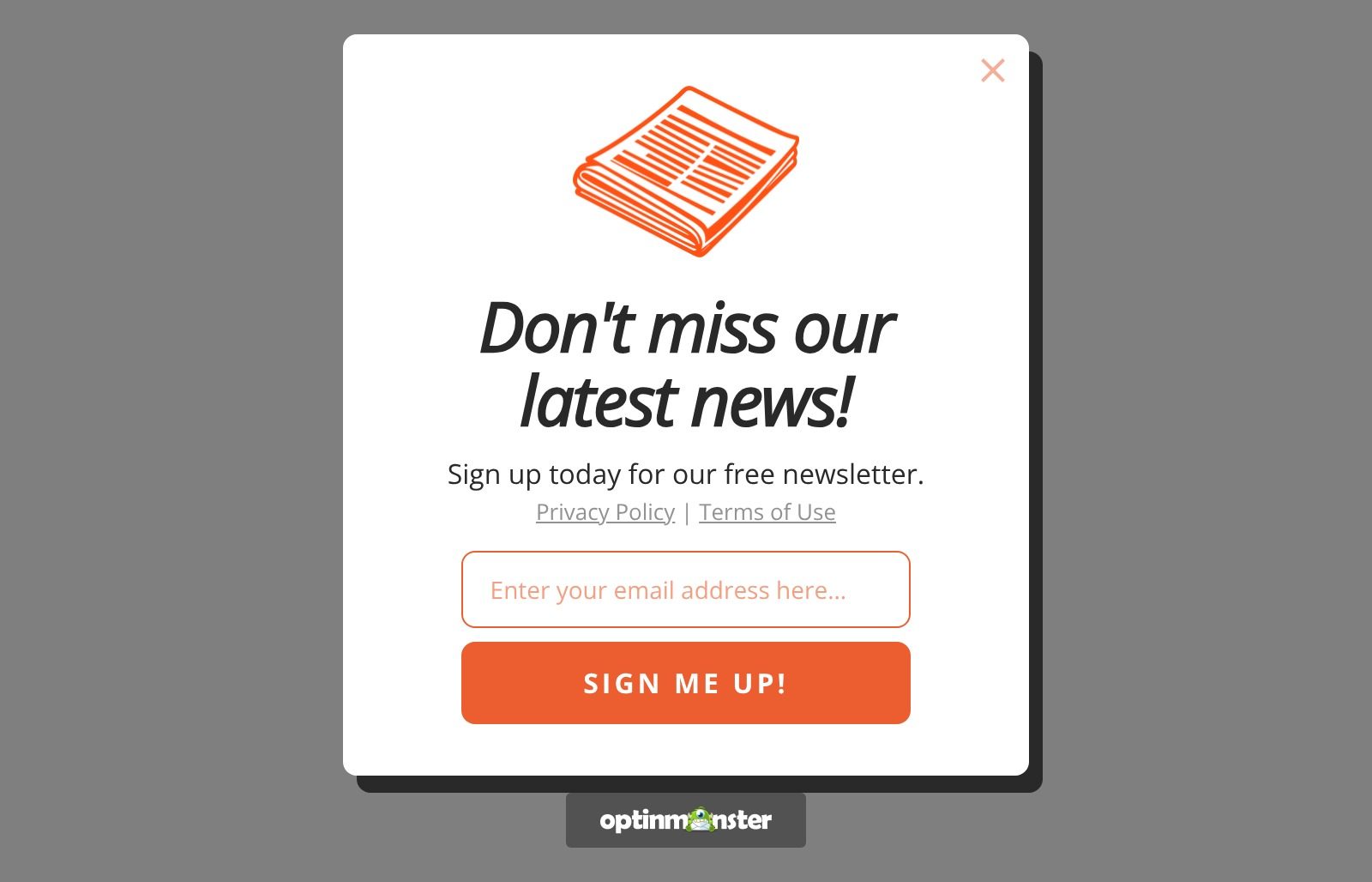
Your welcome subject line should also repeat what the signup form promised. If someone joined through a popup offering your newsletter, then “Your first issue is here” tells them they got what they signed up for.
Here’s a newsletter signup popup built from one of OptinMonster’s templates, for example.
Need more subscribers to welcome?
With OptinMonster, you can turn your website visitors into subscribers with popups, floating bars, slide-ins, and inline forms. Our conversion experts will design 1 free campaign for you, so your signup form is ready before your welcome email is.
Thank You Email Subject Lines
Many businesses put less work into thank-you emails than into sales emails. But when customers get a sincere thank-you, then they may buy again, leave a review, or open your next email.
And they won’t feel like you only wrote to sell them something.
Make sure to thank the person for one specific thing they did, like placing an order, staying subscribed for a year, or sending feedback. Then you can tell them what happens next.
- “Thank you, [First name] — we mean it”
- “Your order is confirmed. Here’s a small thank-you gift.”
- “You made our year. Here’s something in return.”
- “We appreciate you. Here’s what’s coming next.”
- “From our team to yours — thank you”
- “You’ve been with us for a year. Let’s celebrate.”
- “Your feedback helped us improve this — here’s what changed”
- “Because of you, here’s what we built”
Review and Survey Request Email Subject Lines
When you send a review or survey request, you’re asking the customer for a favor. And before they open the email, they’ll likely want to know how big that favor is.
So, it helps to name the product or order in the subject line, along with how many minutes it takes them. Just make sure that number is the real time it takes to finish.
- “How did [Product] work out for you?”
- “Quick question about your recent order”
- “Got [X] minutes? Tell us how [Product] is working.”
- “[First name], would you review [Product]?”
- “One question about your last order”
- “Your review helps the next customer decide”
- “Help us decide what to build next”
- “How was your support chat with [Agent name]?”
Event Email Subject Lines
You can use these subject lines for webinars, conferences, product launches, and live events.
Your first emails need to get people to register. After that, your reminder emails need to get those subscribers to show up.
If you send the early bird line below, then make sure that pricing ends when the subject line says it does.
- “You’re invited: [Event Name] on [Date]”
- “Just announced: [Event Name] registration is open”
- “Seats are filling up — grab yours for [Event]”
- “Reminder: [Event Name] starts tomorrow”
- “Your link to join [Webinar Name] — starts in one hour”
- “[Event Name] recap — here’s what you missed”
- “Early bird pricing for [Event] ends Friday”
- “Join us live: [Topic] — [Day] at [Time]”
Follow-Up Email Subject Lines
Follow-ups can feel uncomfortable to write. But a subscriber who didn’t reply may have just been busy, and a short reminder is easy for them to answer.
So, make sure to keep your follow-up subject line honest and low-pressure, and give them an easy way to say no.
- “Did you get a chance to look at this?”
- “One last nudge — then I’ll leave you alone”
- “You never responded. Totally fine. But…”
- “Still thinking it over? Here are your options.”
- “We saved your cart — it’s waiting for you”
- “You started something — let’s finish it”
- “Re: my last email”
- “One more thing before I follow up again”
Abandoned cart emails have one advantage over other follow-ups. The shopper already picked the product.
So, you only need to remind them what they left and make finishing the order feel easy.
- “You left something in your cart”
- “Your [Product Name] is still in your cart”
- “Still deciding on [Product Name]?”
- “Your cart is saved until [Date]”
You’ll find more lines for store follow-ups in our guide to abandoned cart email subject lines.
Re-Engagement Email Subject Lines
This list is for subscribers who haven’t opened in 60 to 180 days. You only need them to open one email.
So, make sure to keep each line short, direct, and low-pressure.
Someone who has skipped your last few emails will likely scroll past a hard sell. But they’re more likely to open a plain question or a friendly check-in.
- “We miss you, [First name]”
- “Are you still interested in hearing from us?”
- “It’s been a while. A lot has changed.”
- “We saved something for you — but not for long”
- “Should we stay in touch? Yes or no.”
- “Before we say goodbye — one last offer”
- “Your account has been quiet. We noticed.”
- “Here’s what you’ve been missing”
Cold Email Subject Lines
Cold email subject lines are for first-touch outreach to people who haven’t opted into your email list. So, you need to give them an honest reason for the email in the subject line, such as a referral, a post they wrote, or a result for a similar company.
Keep in mind that the people you contact never subscribed to hear from you. So, if they mark your email as spam, then your sender reputation can suffer, and fewer of your future emails may reach the inbox.
Some email marketing services don’t allow cold email at all. Make sure to check your email marketing service’s terms before you send.
- “Quick idea for [Company Name]”
- “Saw your post on [Topic] — had a thought”
- “Mutual connection suggested I reach out”
- “Question about your recent [announcement or article]”
- “I helped [similar company] achieve [specific result] — curious if relevant”
- “Noticed you’re hiring a [role]”
- “[Referral name] suggested I send this”
- “Two sentences on why I’m emailing”
Newsletter Subject Lines
I write OptinMonster’s weekly newsletter, and I want subscribers to know what’s in each issue before they open it.
So, I recommend naming the top story, the date, or how many picks are inside.
- “This week’s must-reads — [date]”
- “What we learned this week”
- “The [Brand] weekly: [teaser of top story]”
- “Three things worth your time this Friday”
- “What everyone’s talking about in [industry]”
- “Your [weekly or monthly] roundup is here”
- “The story everyone missed this week”
- “What’s working in [industry] right now”
Holiday and Black Friday Email Subject Lines
In a holiday week, subscribers often get sales emails from many of the brands they follow. So, make sure to put the occasion and the offer in the first few words of the subject line.
You could also add a deadline.
For full campaigns built around these lines, see our guide to Black Friday email examples.
- “Halloween deals, no tricks: [X]% off until [date]”
- “Black Friday starts now: [X]% off everything”
- “[First name], your early access to Black Friday is open”
- “Last call: our Black Friday prices end at midnight”
- “Cyber Monday only: [offer] until [time]”
- “Order by [date] for delivery before Christmas”
- “The gift guide for the [audience] who has everything”
- “New year, new [goal]: [X]% off to get started”
- “A Valentine’s Day treat for you (and someone else)”
Words and Phrases That Boost Open Rates
Email marketers reach for these power words again and again. But no single word will work for every email list.
So, it’s worth testing each one on your own subscribers.
- “You” and “your”: Talking to people directly usually feels more personal than writing about “customers”
- Numbers (“7 ways,” “30 days,” “three mistakes”): With a specific figure, subscribers know what to expect, and the promise can be easier to believe
- “Free”: Still effective for content offers and trial invitations, as long as the offer really costs nothing
- “Now” and “today”: Tells subscribers the offer is happening right now. Use it only when that’s true
- “New”: Subscribers are often curious about something new. So, you may want to save the word for an actual launch or update
- “Because”: When you give a reason for what you’re asking, then subscribers may find the request easier to say yes to
- “Easy” and “simple”: Readers expect a quick task when they see these words. So, make sure the task really is quick before you use them
- “Proven”: Subscribers may trust the word more when the email shows the result behind the claim
- “Exclusive”: Tells subscribers they’re getting something other people aren’t. So, make sure to keep the word for offers limited to your subscribers
- “Reminder”: Fits well in a follow-up sequence, pointing back to an earlier email without adding pressure
You can also use an AI writing tool to draft subject line options quickly. You could give the tool your email’s main point, your audience, and two or three words from this list, then ask for several variations.
You could ask for preview text in the same prompt.
Keep in mind that you won’t know which subject line your subscribers will open until you test the options. So, make sure to pick your two strongest options and A/B test them against each other in your email marketing service.
Email Subject Line Mistakes to Avoid
Before you send a campaign, check each subject line against these six mistakes.
- All caps or excessive punctuation. Spam filters may flag a subject line like “OPEN THIS NOW!!!” And to the person reading it, it can look desperate.
- Vague subject lines. Readers have no reason to open “Check this out” or “Important update.” Make sure to say what’s inside the email.
- Misleading subject lines. A subject line that doesn’t match the email content can destroy trust fast. Subscribers may stop opening your emails, and some may unsubscribe.
- Subject lines too long for a phone screen. A mobile inbox can cut a long subject line off. Make sure to put the value in the first few words.
- Spam trigger words. Spam filters and readers may treat an email as suspicious when it uses phrases like “free money,” “act now,” and “100% guaranteed.” In ZeroBounce’s 2026 survey, 80% of people said they mark an email as spam when it looks like spam.
- Skipping the A/B test. Most email lists respond a little differently. If you’re not testing, then you’re guessing.
To try two subject lines against each other, send each one to a small, equal group from your email list. Most email marketing services can split the list for you.
I’d pick the winner by clicks, not opens. Opens can include people who never read the email.
When one version wins, you can send it to everyone else on your email list. Our guide on how to split test your email newsletters walks through the full setup.
Subject line writing gets better with repetition. For your next campaign, try picking one formula, writing two versions, and testing them against each other.
After a few campaigns, you should start to see which kinds of subject lines your subscribers open.
Frequently Asked Questions About Email Subject Lines
What is a good email open rate?
A good email open rate is one that beats your own previous sends to the same list. Our guide to what makes a good email open rate covers the published averages and why they’re hard to compare against.
Apple’s Mail Privacy Protection can record opens that nobody actually made. So, compare your open rate with your own past campaigns, and watch your clicks as well.
How long should an email subject line be?
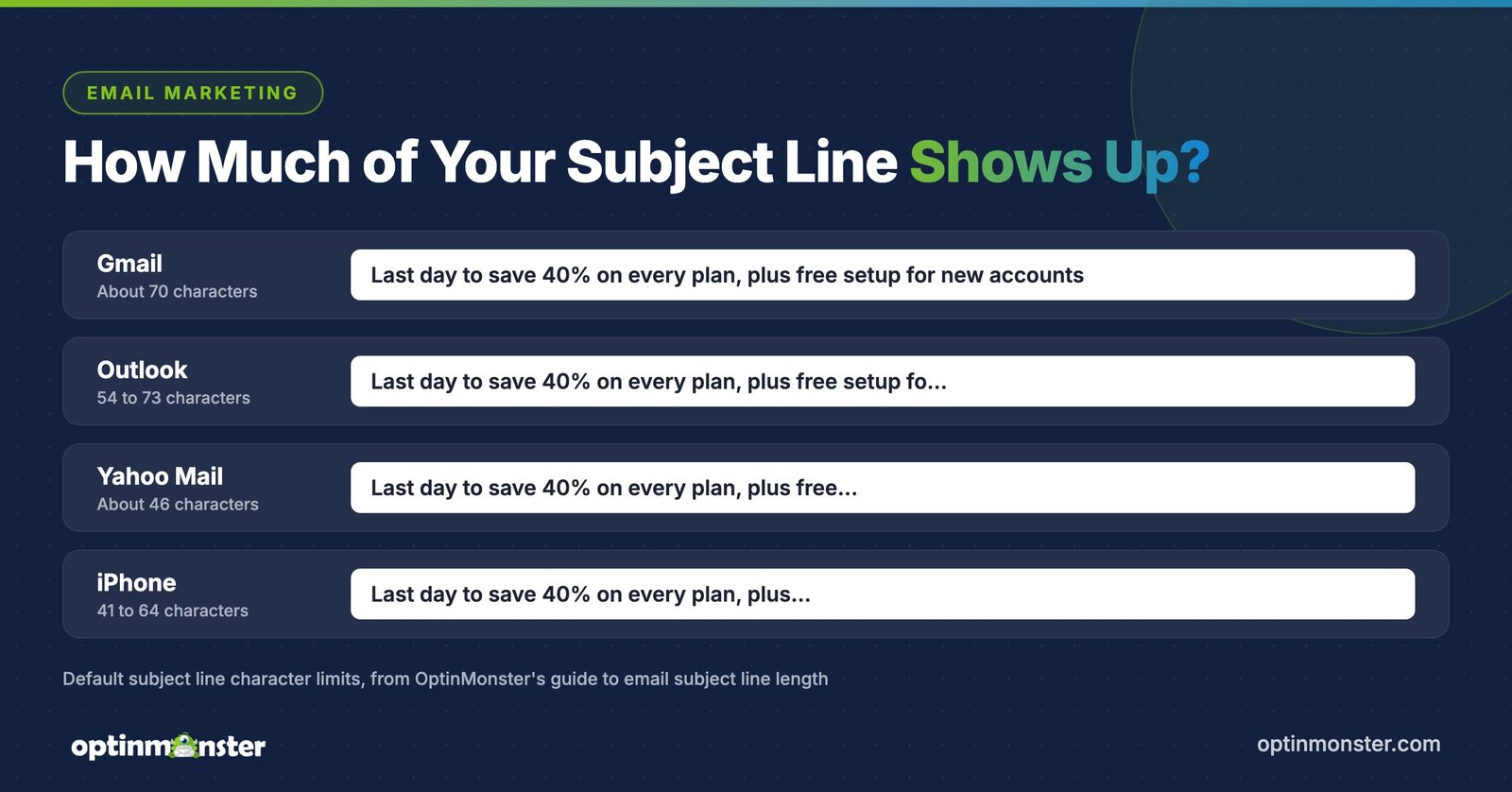
Try to keep an email subject line under 10 words and between 20 and 40 characters. Some inbox apps cut the line off sooner than others: Yahoo Mail shows about 46 characters, while Gmail shows about 70.
So, it’s worth putting the most important words first, where most inboxes will show them.
What words should I avoid in email subject lines?
It’s best to avoid phrases that read like spam, such as “free money” and “100% guaranteed.” The same goes for strings of exclamation marks or dollar signs. Spam filters can flag them, and so can your subscribers.
So, try to write each subject line the way you’d write to one person you know.
Should I use emojis in subject lines?
Yes, when they fit. A single relevant emoji at the start or end of a subject line can help your email stand out in a crowded inbox.
Random or repeated emojis can look spammy, though.
Does the sender name affect open rates as much as the subject line?
It can. Subscribers see the sender name right beside the subject line.
So, choose a sender name your subscribers will recognize and keep it the same on every send. Then they can turn to the subject line to decide whether this particular email is worth opening.
Start Growing Your Email List
Subject lines matter most when you have enough subscribers to send them to.
OptinMonster is the tool we built to help with that. You can use its campaigns to turn your website visitors into email subscribers. So, the email list you send to keeps growing.
It also helps to match the signup offer to the page. With OptinMonster’s display rules, you can show a different campaign on different pages, like a gift guide on your holiday pages and a size chart on your product pages.
Then each group of subscribers joins for a clear reason. And that reason gives you something specific to put in your subject lines.
Disclosure: Our content is reader-supported. This means if you click on some of our links, then we may earn a commission. We only recommend products that we believe will add value to our readers.
33 responses to “150+ Best Email Subject Lines: Examples That Actually Get Opened (2026)”
-

Great we need more post like this!
-

So glad you enjoyed it, Eduardo!
-
thanks,was so helpfull
-
Mary can you please help me write a great introductory email to several new clients? I am in the transportation/logistics industry.
Thank you!
-
We’ve got some great examples of promotional emails, Alejandro. Hope this helps. 🙂
-
-
-
-
This post is fantastic! Thank you!!!
-
So glad you enjoyed it, Jennifer!
-
-
For any brand today, yearning for an effective online presence, it is must have to increase the email open rates. And without a doubt, an eye catching email subject lines is one such way to grab the user’s attention which make readers prompt to read emails.
-
Awesome! keep it coming
-
Simply Awesome !!!
-
Glad you enjoyed it, Govind! 🙂
-
-
I feel that is among the most significant information for me. And i’m happy studying your article. However wanna commentary on few normal things, The site taste is great, the articles is really excellent : D. Excellent job, cheers
-
I’m learning how to write catchy subject lines, and this article was very helpful. Thank you!
-
I’m so glad this was helpful for you, Kevin! 🙂
-
-
Very helpful, thanks for sharing.
-
When asking a company for something like a donation or samples of their products what is the best thing to say in the subject line of your email?
-
Hi, Kelly. Great question. We’ve got an article on how non-profits can use email marketing to increase donations that you might find useful. Don’t forget to follow us on Twitter and Facebook to get more tips on email subject lines and other marketing topics.
-
-
Hey Mary,
Your blog is excellent. However, Subject lines mentioned in your blog doesn’t suit at professional level. Could you please help me in figuring out subject lines while sending a professional email to a stranger asking for a favour?
Thanks in advance.
-
Hi Vereendra, you’re right; this article is about email marketing, rather than writing letters. Maybe this article where people dissect their most successful subject lines will provide some inspiration? Hope that’s helpful, and please follow us on Twitter so you’ll know immediately when we publish something new on this topic.
-
-
Mary thanks a lot! This is very helpful and easy to read!
-
Glad you found it helpful, Novelyn. Check out our post on running an email marketing campaign for more tips. 🙂
-
-
Hey there! Thank you for all of the information on your site! I’ve found a lot of it helpful, as email marketing has been very challenging for me, but I did notice that there’s some contradicting info in this article with another from your site. In the above article, there are several examples that use words that are also said to flag spam filters in the article titled “11 Reasons Why Your Emails Go in the Spam Box (and How to Make Sure They Don’t)” and in the “this comprehensive list” link under the #10 heading of that article. Can you clarify for me? I have very low open rates with my emails and I want to make sure I’m understanding what I’m getting wrong. Your expertise is much appreciated! Thanks again for the time spent gathering all of the info in your articles and for your advice! 🙂
-
Hey Katie, great question! It’s true that it’s smart to avoid certain words that can be associated with spammy emails. However, using those words won’t necessarily automatically flag your email as spam – rather they’re just one of many signals that email services look for when deciding whether or not an email is spam.
If you’re writing good subject lines, following deliverability best practices, and keeping your email list cleaned, and still seeing low open rates, it could be that your emails aren’t targeted towards your subscribers’ interests. For example, if someone signs up for vegan recipes and starts getting emails with hamburger recipes, they aren’t likely to open them. That’s an extreme example, but the more targeted your emails are to your subscriber’s interests, the better your engagement will be. That’s one reason why it’s important to segment your list.
Hope that helps!
-
-
This article was very helpful! Thanks for sharing!
-
Mary,
These subject lines are awesome. U copied some of them so I can use for email marketing. This is like a gold cave for email marketers. Thank you.
-
Hmm it appears like your site ate my first comment (it was super long) so I guess I’ll just sum it up what I wrote and say, I’m thoroughly enjoying your blog. I too am an aspiring blog writer but I’m still new to the whole thing. Do you have any tips for beginner blog writers? I’d genuinely appreciate it.
-

Hi Larry! Glad you’re enjoying the blog. Our friends at WPBeginner have written a comprehensive guide to starting a blog: https://www.wpbeginner.com/start-a-wordpress-blog/ Hope this helps!
-
-
Wow, what an incredibly detailed and informative guide on crafting effective email subject lines! The breakdown of different types of subject lines, along with numerous examples, really helps illustrate the principles at work. I particularly appreciate the emphasis on understanding the psychology behind subject lines and how they can influence recipient behavior.
Your inclusion of various strategies, from leveraging FOMO to using emojis, provides a comprehensive toolkit for marketers looking to optimize their email campaigns. Additionally, the best practices and common mistakes sections offer valuable insights for ensuring that subject lines not only capture attention but also deliver on their promises.
Overall, this post serves as an invaluable resource for anyone looking to improve their email marketing efforts. Thanks for sharing such valuable tips and examples!
-
Awesome! thanks for the post
-
Hmm I’m curious, is there any hidden tips when it comes to SEO?
Because, my business has not been performing well lately.-
We have several articles that can help you with your site’s SEO. Here are a few to get you started:
• SEO Beginner’s Guide: Learn the Basics + Top Tips
• 10 SEO Ranking Factors
• 15 SEO Tips for Instant Traffic Boost
• On-Page SEO Checklist: 10 Steps to Better Search Rankings
• What Is Off-Page SEO? 15 Proven Tips
-
-
The six-formula framework is a useful way to sort subject lines, and the point that word count beats character count matches what I’ve seen in most inbox tests. The caveat about Apple’s Mail Privacy Protection inflating open rates is worth repeating more often too.
-
The six formulas breakdown is the most useful part here — mapping every example back to curiosity gap or urgency makes the list actually actionable instead of just a pile of lines. The point about behavioral personalization outperforming a first-name insert is worth repeating, since most guides stop at “add their name.”


Add a Comment